
Most arguments do not begin where we think they do. They begin earlier. Beneath the data. Beneath the tone. Beneath the visible disagreement about what should be done. They begin in assumptions, usually unspoken, often unexamined, occasionally inherited like a family recipe that no one remembers choosing.
You can watch it happen. Two managers sit across a table. One says,
‘We need tighter controls’.
The other replies,
‘We need more trust’.
The volume rises. Each cites examples. Each believes the evidence is obvious. The conversation circles like a dog chasing its tail.
What neither has said aloud is the premise beneath their claim.
The first assumes that people, left unsupervised, will drift. The second assumes that people, trusted, will rise. They are not arguing about spreadsheets. They are arguing about human nature.
Until that assumption surfaces, the disagreement will not resolve.
Hidden assumptions are powerful because they feel like facts. They sit so close to the bone that questioning them feels personal. If you assume that conflict is harmful, then a colleague who argues robustly appears aggressive. If you assume that conflict is productive, that same colleague appears engaged. The behaviour has not changed. The lens has. The danger of hidden assumptions is not that they exist. Everyone has them. The danger is that they operate unchallenged.
How Hidden Assumptions Shape Decisions
In organisations, assumptions accumulate quietly.
‘This team never delivers on time.’
‘Senior leadership doesn’t listen.’
‘Clients only care about price.’
Each sentence becomes a lens. Future events are interpreted through it. Evidence that confirms the assumption is noticed. Evidence that contradicts it is dismissed as an exception. Over time, the assumption hardens into identity.
Consider a project that overruns its budget. One interpretation is, ‘The team lacked discipline’. Another is, ‘The scope was poorly defined’. A third is, ‘External conditions shifted’. Each interpretation carries an assumption about causality. Without examining those premises, any solution will be partial.
Blame discipline and you tighten oversight. Blame scope and you improve planning. Blame external volatility and you build contingency. The actions differ because the assumptions differ.
Surfacing assumptions is uncomfortable because it moves the conversation from what happened to what we believe. It requires questions such as,
‘What are we taking for granted here?’
‘If this conclusion is correct, what must also be true?’
‘What belief sits underneath this claim?’
These are not aggressive questions. They are clarifying ones. Yet they feel intrusive because they ask people to expose their mental scaffolding.
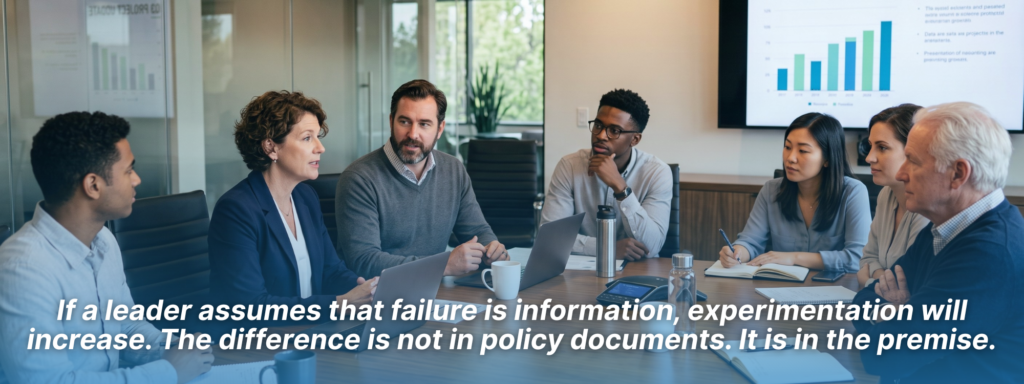
There is a temptation to treat assumptions as intellectual curiosities, suitable for philosophy seminars but unnecessary in operational life. That is a mistake. Assumptions drive resource allocation. They drive hiring decisions. They drive risk tolerance. If a leader assumes that failure is a sign of incompetence, innovation will shrink. If a leader assumes that failure is information, experimentation will increase. The difference is not in policy documents. It is in the premise.
Examining Hidden Assumptions
Hidden assumptions also shape how we interpret data. Two analysts examine the same report. One sees decline and concludes, ‘The strategy is flawed’. The other sees decline and concludes, ‘The market is contracting’. Their responses diverge because they begin from different expectations about stability and change. Without surfacing those expectations, debate remains superficial.
The practical skill here is modest and demanding. When a strong conclusion is voiced, pause. Ask, ‘What must be true for that to hold’. The answer reveals the assumption. Once visible, it can be examined.
Is it supported by evidence.
Is it outdated.
Is it universally valid or context-specific.
This process does not guarantee agreement. It does guarantee clarity.
In personal relationships, the stakes are no lower. Assume that silence means disapproval and you react defensively. Assume that silence means reflection and you wait. The same behaviour produces different emotional responses depending on the premise you carry.
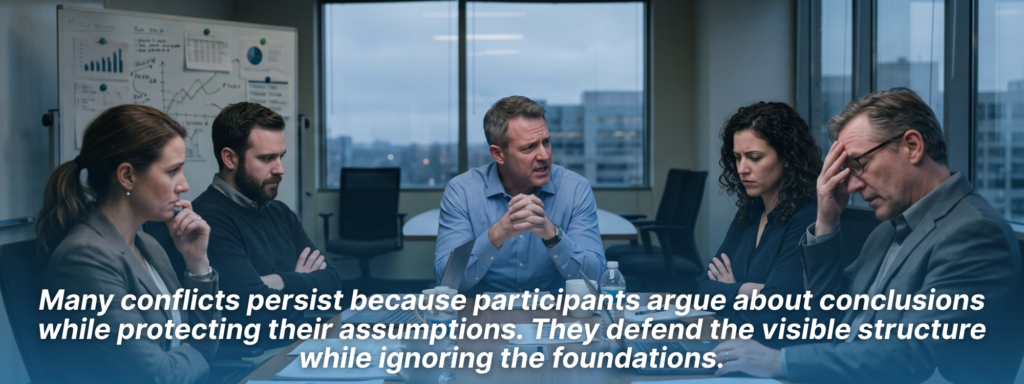
Many conflicts persist because participants argue about conclusions while protecting their assumptions. They defend the visible structure while ignoring the foundations.
The moment assumptions are articulated, something shifts. The heat often decreases. Instead of accusing each other of error, participants can examine the premises themselves. ‘You assume that tighter control improves performance.’ ‘Yes.’ ‘I assume that autonomy improves performance.’ ‘Yes.’ Now the disagreement is visible. It can be tested against experience rather than fought over as a matter of personality.

Leading with Examined Beliefs
There is also a humility built into this practice. Recognising that one’s view rests on assumptions tempers certainty. It invites the possibility that those premises may be incomplete. That humility is not weakness. It is adaptive strength.
Leaders who model this approach create a different atmosphere. They invite dialogue when they say:
‘My view rests on the belief that our team responds best to clear direction’
They expose their own scaffolding. Others feel permitted to do the same. The alternative is rigidity. When assumptions remain hidden, challenges feel like personal attacks. Defensiveness rises. Conversation narrows. Surfacing assumptions does not mean abandoning conviction. It means anchoring conviction in examined ground.
There is a further benefit. Assumptions often explain repeated patterns of failure. If a team consistently underestimates timelines, perhaps it assumes that best-case scenarios are typical. If safety incidents recur, perhaps there is an underlying belief that minor shortcuts are harmless. Naming these beliefs is the first step towards altering them. Without naming, correction is cosmetic.
The professional benefit is clear. Better decisions arise from clearer premises. Fewer surprises emerge because hidden beliefs have been interrogated. Strategies align more closely with reality.
The personal benefit is equally valuable. Working in a culture where assumptions can be examined without ridicule reduces defensiveness. It fosters intellectual honesty. It encourages growth rather than entrenchment.
Every argument rests on something unseen. Like a building on its foundations, the visible structure depends entirely on what lies beneath. Ignore the foundations and cracks will appear in the walls. Examine them and you may find they need reinforcement, adjustment, or replacement.
The choice is simple. Argue about conclusions endlessly, or descend a level and inspect what supports them. The latter requires courage. It also produces clarity.
And clarity, unlike assumption, withstands pressure.