
The room goes quiet when someone says,
‘I know exactly what’s happening’
There is relief in it. Shoulders lower. Pens stop fidgeting. The fog appears to lift. The mess of half-formed thoughts and competing interpretations collapses into a single line of direction. It feels like oxygen after a long climb. Certainty is comforting. It steadies the pulse. It reduces the noise. It tells us that someone, somewhere, has a map. The trouble is that maps can be wrong.
In high-stakes environments, certainty spreads quickly. A leader names the problem. A colleague nods. Another repeats the diagnosis as though it were self-evident. Within minutes, the narrative has hardened. ‘It’s a performance issue.’ ‘It’s a culture problem.’ ‘It’s the market.’ The explanation sounds plausible. Plausibility is often enough to win the day. No one enjoys standing in front of a team and saying,
‘I am not sure yet’.
Uncertainty feels like exposure. It suggests vulnerability. It invites challenge. It leaves a vacuum in which doubt might breed. Certainty, by contrast, carries the clean lines of authority. It signals competence. It feels decisive. Which is precisely why it seduces us.
The High Cost of Misplaced Confidence
Consider a common scene. Sales dip for two consecutive quarters. The executive team convenes. One voice declares,
‘The issue is complacency. We’ve lost our edge’.
The language is sharp, almost surgical. Complacency is a tidy villain. It can be attacked. It can be disciplined. The remedy seems obvious. Increase targets. Tighten oversight. Replace underperformers. The plan is rolled out with urgency. Activity spikes. Morale dips. The numbers wobble, then fall again.
Only later does someone quietly observe that a new competitor entered the market six months ago with a cheaper model and aggressive pricing. The team was not complacent. It was outflanked. The earlier certainty was bracing. It was also misplaced.
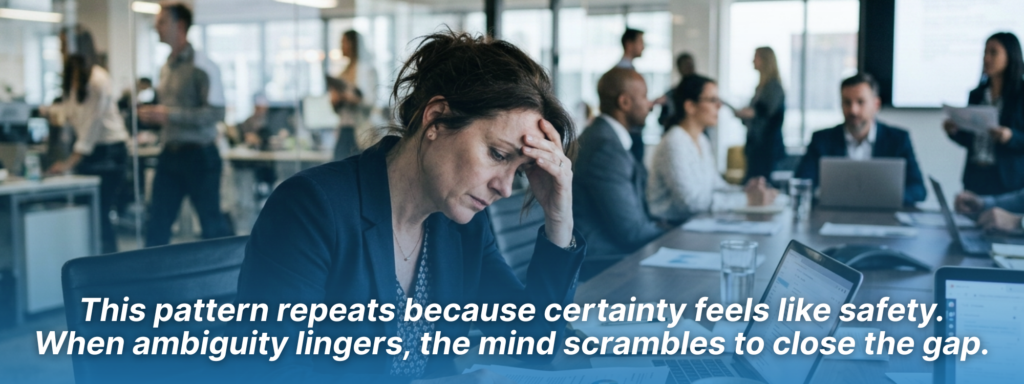
This pattern repeats because certainty feels like safety. When ambiguity lingers, the mind scrambles to close the gap. Open questions are uncomfortable. They hum at the edge of awareness like a faulty transformer. They demand attention without offering resolution. A clear answer, even a weak one, silences the hum.

Social Rewards and the Nuance Gap
In conversation, you can see it happen. A debate meanders. Evidence is mixed. Interpretations clash. Then someone states a firm conclusion with the confidence of a man announcing tomorrow’s weather. Others, weary of ambiguity, align. The conversation ends not because truth has been secured, but because tension has been reduced.
There is a social reward for decisiveness. Those who speak with conviction are often perceived as stronger, even when the foundation beneath their claims is thin. Those who hedge are viewed with suspicion.
‘Why can’t you just say what you think?’
The implication is that nuance is evasion. Yet nuance is often the first sign of careful thought.
The discipline required here is not paralysis. It is proportion. Some situations demand swift action. If a machine overheats, you shut it down. If a safety risk is visible, you intervene. Clear cause and effect invite clear response. The danger arises when we treat ambiguous, shifting situations as though they were simple faults.
Complex environments produce mixed signals. Causes intertwine. Effects lag behind actions. In such settings, early certainty is often premature. The first explanation is rarely the only one. It may not even be the most plausible.
Leading Through Disciplined Inquiry
A leader provides something sturdier than false clarity when they can say,
Here is what we know.
Here is what we do not yet know.
Here is what we will test.
They provide direction without pretending to omniscience.
This requires a shift in posture. Instead of racing to answer, the leader becomes a disciplined inquirer. What evidence supports this claim. What evidence contradicts it. What assumptions are we making without noticing. Who sees this differently and why.
These questions slow the rush to closure. They feel awkward at first. They disrupt the comfortable glide towards consensus. They invite dissent. That invitation is precisely the point.
When dissent is surfaced early, weak explanations are exposed before they harden into policy. When alternative interpretations are examined, blind spots shrink. The room may feel less tidy, but it is more honest.
There is also a cultural component. Teams learn quickly whether certainty is prized above accuracy. In some organisations, bold claims are rewarded even when they collapse later. The collapse is blamed on execution, not on flawed diagnosis. Over time, this pattern trains people to speak with confidence rather than care.
The Habit of Resilience and Certainty
In healthier cultures, intellectual humility is not equated with weakness. It is recognised as discipline. When someone says,
‘I might be wrong, but here is how I see it’
The statement is not dismissed. It is examined. The conversation deepens rather than narrows.
The practical benefits are measurable. Decisions grounded in broader inquiry tend to require fewer reversals. Resources are allocated with greater precision. Blame decreases because understanding increases. Performance stabilises because actions are aligned with reality rather than assumption.
The personal benefits are quieter but significant. Working in an environment where uncertainty can be voiced reduces the pressure to perform certainty. People can admit gaps in knowledge without fearing ridicule. That safety encourages learning. Learning encourages adaptation. Certainty, by contrast, often closes the door just when it should be left ajar.
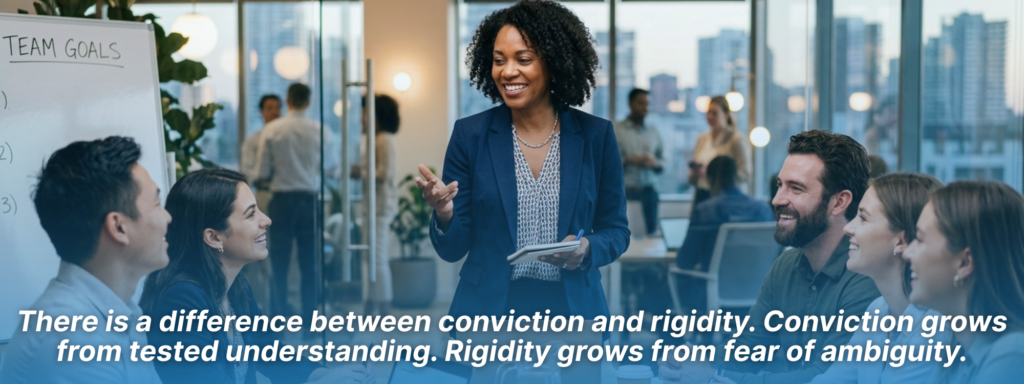
There is a difference between conviction and rigidity. Conviction grows from tested understanding. Rigidity grows from fear of ambiguity. The former strengthens over time. The latter fractures under strain.
In public discourse, the seduction of certainty is amplified. Media rewards sharp soundbites. Social platforms favour bold claims over measured analysis. The loudest voice often travels furthest. Yet volume is not validity.
For leaders, the challenge is to resist being pulled into that current. To recognise that the pressure to appear certain can override the responsibility to think carefully.
This does not mean languishing in indecision. It means sequencing. First, understand as fully as possible. Then decide. Then review. Certainty, if it emerges, should be the product of examination, not the substitute for it.
A useful habit is to ask, before committing to a conclusion, ‘What would change my mind’. If the answer is ‘nothing’, the conclusion may be more identity than insight. If the answer identifies specific evidence or conditions, the reasoning retains flexibility. Flexibility is not weakness. It is resilience.
In complex environments, survival rarely belongs to the loudest voice. It belongs to those who can adapt without losing coherence. Adaptation requires the willingness to revise earlier views. Revision requires the humility to admit that first impressions may have been incomplete. The seduction of certainty will not vanish. It is part of human wiring. Clear answers calm the nerves. They reduce tension. They offer direction. The task is not to banish certainty, but to earn it.
When certainty arises from disciplined inquiry, it steadies teams rather than misleads them. When it is declared too early, it becomes a trap. In leadership, the difference between the two is often the difference between temporary relief and lasting effectiveness. Relief feels good in the moment. Effectiveness endures.
Choose accordingly.