An Earnest Misunderstanding
It is a rare treat to encounter an essay so steadfast in its commitment to earnestness that it almost—almost—escapes scrutiny. The argument presented in Fairness & Objectivity is like an intricately woven tapestry, the sort that upon first glance appears robust, only for a single, well-placed tug to unravel the entire thing.
The premise? That leadership is neither about being ruthlessly objective nor indulgently fair, but about a miraculous balancing act between the two. A noble sentiment, to be sure, but one that raises an obvious question:
“Why do the most powerful leaders in history appear to have entirely ignored it?”
Let us, then, conduct a delicate operation. The patient—this argument—will not survive, but the autopsy will be instructive.
The Art of Making No One Happy
The essay begins with an unassailable truth: leadership is not a matter of ‘ticking boxes.’ A strong opening—no one likes a bureaucrat with the soul of an Excel spreadsheet. But having seduced us with common sense, the argument then veers into far more treacherous territory: ‘leaders who over-rely on objectivity risk alienating stakeholders, while those who over-prioritise perceived fairness risk decision paralysis.’ This, presumably, is meant to feel revelatory rather than obvious.
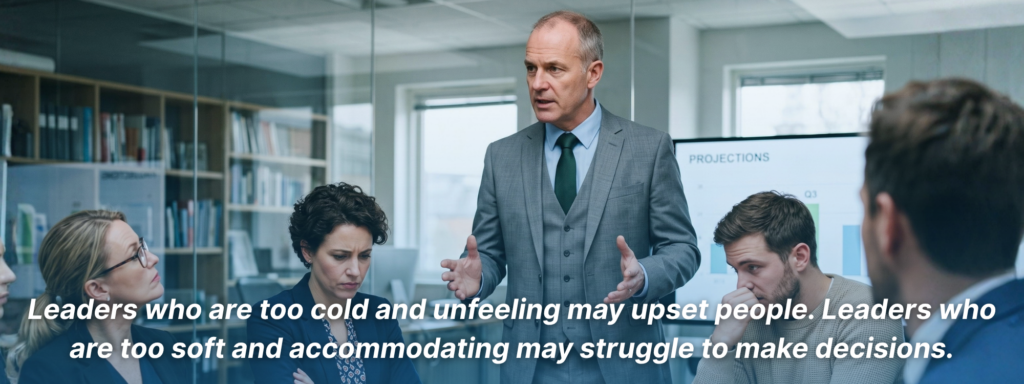
Yes, indeed. Leaders who are too cold and unfeeling may upset people. Leaders who are too soft and accommodating may struggle to make decisions. This is wisdom of the highest order, akin to warning a tightrope walker that leaning too far in either direction might lead to a fall.
The deeper problem, of course, is the assumption that fairness and objectivity are somehow in opposition. One might just as well argue that a surgeon must find the perfect balance between precision and hygiene. Fairness, in this model, is framed not as a virtue in itself, but as a sort of warm lubricant to help people swallow bitter but necessary decisions. ‘We’re cutting your department, but we really want you to feel good about it.’
But if fairness is just a perception game, then what distinguishes it from good public relations? And if fairness must be paired with objectivity to be effective, is it anything more than a well-dressed servant to cold, rational decision-making?
The Curious Case of ‘False Balance’
One of the essay’s more entertaining diversions is its critique of ‘false balance’—the idea that presenting two opposing views equally can distort reality. An excellent point, but it collapses under the weight of its own logic.
Take, for instance, its use of Behzti, a play that caused protests among religious communities. The argument suggests that media debates framed it as ‘secular free speech versus religious protest’ rather than seeking a ‘nuanced middle ground.’ A charming thought, but one wonders: what precisely was this middle ground? A play that was only half performed? Religious protests conducted at an acceptable volume?
The real complaint here is not that the framing was adversarial, but that it failed to reach the correct conclusion. One suspects that if the media had presented a ‘nuanced’ view which just happened to favour the essay’s perspective, there would be no complaint at all. The problem with ‘false balance,’ then, is not its existence, but its refusal to reach the pre-approved answer.

The Metaphor That Devours Itself
And now, a moment of sincere applause. The metaphor comparing fairness to ‘predator-prey dynamics in an ecosystem’ is a triumph of unintended irony. It paints fairness not as a kindly force for good, but as a natural mechanism that ensures ‘long-term stability.’ And indeed, it is difficult to argue against the stabilising effects of being devoured by a lion.
But here’s the rub: predators maintain order not through empathy, but through ruthless efficiency. They do not host town halls with the local gazelle population to discuss how they would prefer to be eaten. They act, and the system absorbs the shock. If fairness is to function in leadership as it does in nature, then it is merely a euphemism for strategic domination—kindness wielded as a weapon of control.
This, of course, would be an excellent argument. It is merely unfortunate that the essay does not realise it has made it.
PR Becomes Ethics
The essay delights in presenting Toyota’s approach to layoffs as a paragon of fairness, contrasting it with the blunt force trauma of General Motors’ redundancies. The implication is clear: Toyota, in its wisdom, made people feel better about being sacked.
Splendid. And yet, one cannot help but notice that Toyota’s laid-off workers remain just as unemployed as GM’s. Perhaps they enjoyed a more pleasant farewell email. Perhaps there was a commemorative PowerPoint slide. But was fairness truly served?
The more unsettling takeaway is that perception is being treated as the ultimate measure of fairness. Layoffs are not actually the problem—only the optics of them. But this invites a troubling conclusion: if an unfair process is simply presented well, does it become fair?
One suspects the answer is yes. Which is precisely why this entire argument begins to feel more like a course in advanced corporate PR than a genuine exploration of leadership ethics.
The Unfairness Fiction
Ah, here we reach the true heart of the matter. ‘Leaders who impose top-down, purely objective decisions without considering perception risk triggering resistance.’
Do they? A cursory glance at history suggests that those who wielded power with absolute ruthlessness—Julius Caesar, Napoleon, Steve Jobs—seemed to do rather well. In fact, many of history’s greatest leaders appear to have treated fairness with the same level of enthusiasm one might reserve for an unseasoned tofu burger.
The Netflix example, in which ‘radical objectivity’ is ‘tempered with structured fairness,’ is particularly amusing. Netflix, after all, has built its reputation on a ‘high performance’ culture, which is a lovely euphemism for ‘we will fire you if you are not exceptional.’ The fairness, then, lies in the fact that everyone is equally disposable. It is objectivity with a PR facelift.

A Bureaucratic Delusion
The solution proposed—‘Fair Process Leadership’—is a masterpiece of consultancy jargon. It promises structured engagement, transparent decision-making, and stakeholder involvement. It is, in essence, the IKEA instruction manual of leadership strategies: long, convoluted, and inevitably missing one crucial screw.
The real function of ‘fair process leadership’ is to convince people that their input matters, even when it demonstrably does not. It is a technique perfected by governments when they hold ‘public consultations’ before making a decision they had already planned to implement. It is, in other words, a rather elegant form of deception.
A Dangerous Question
And so we reach the final, delicious irony. The essay assures us that ‘leadership is not about being right, but about creating conditions where people trust the process.’
Which invites a rather mischievous question: if fairness is merely a tool to ensure compliance, does it actually exist at all? Or is it simply a necessary fiction, a soothing bedtime story for those who must live with the consequences of power?
The best leaders, one suspects, are not those who balance fairness and objectivity. They are the ones who make their followers believe that whatever happens was their idea all along.
And with that, I leave the reader to ponder: is fairness a stabilising force, or simply the prettiest disguise power has ever worn?