
The kettle had just clicked off when it began.
Nothing dramatic. No plates smashed. No voices raised. Just a small tightening in the jaw as he watched her scrape burnt toast into the bin. She said something about the school email. He heard something else. Not the words, exactly. The tone. Or what he thought was the tone. It brushed against him like a draught under a door.
His shoulders lifted half an inch. He did not notice.
She turned, butter knife in hand, and said, ‘Did you reply to them?’
A reasonable question. Eight syllables. Harmless on paper.
His breath shifted higher in his chest. Still subtle. Still deniable.
‘Not yet,’ he said.
That was the moment.
Not the argument that followed. Not the sharpness that crept into the next sentence. Not the way the kitchen seemed suddenly smaller, as if the cupboards had edged closer to enjoy the show. The moment was here, in that faint tightening, in that breath that forgot how to finish itself.
Most of us miss it.
We think the trouble begins when the voice rises. When the door shuts harder than necessary. When the email is fired off with a speed that would impress a marksman. We mark the explosion and call that the beginning. It is not. The explosion is the sequel. The beginning is quieter. It has the courtesy not to announce itself.
The Body Knows First
It happens in cars as well. A red light that stays red just a little too long. A driver who fails to indicate. The hand tightens on the wheel. The tongue presses against the roof of the mouth. A muttered ‘for God’s sake’ slips out before you have quite decided to say it. That is the beginning.
Or at a party. A roomful of strangers. Laughter that sounds slightly too loud. You scan the room with the urgency of a hungover snail, slow and suspicious. Your shoulders inch upward. Your eyes drop to your phone, loyal servant that it is. ‘I don’t belong here,’ you think. The evening has not gone wrong yet. It is simply preparing to.
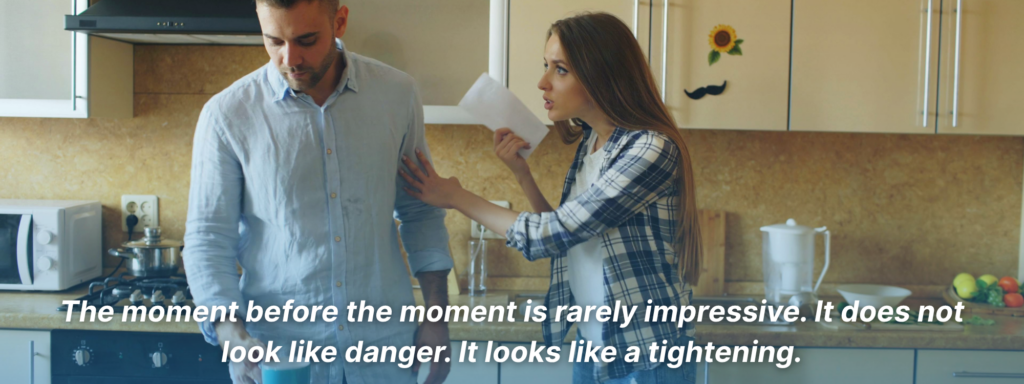
The moment before the moment is rarely impressive. It does not look like danger. It looks like a tightening. A leaning forward. A breath that stops short of its full length. The body adjusts its stance as if bracing for a punch that may never land.
By the time we notice the raised voice, we believe we have lost control. By the time the message is sent, we say, ‘I couldn’t help it.’ But the truth is less dramatic and more hopeful. The loss did not happen in the shout. It happened in the inching upward of the shoulders. In the breath that shortened. In the jaw that set itself like wet cement.
You have felt it. You have dismissed it. You have called it nothing.
Moment Before Things Shift
It is not nothing.
It is the first movement of a chain reaction. And if you learn to live there, in that small, almost polite tightening, you discover something quietly radical. The storm does not begin with thunder. It begins with pressure. And pressure, if you notice it early enough, can be eased before it becomes weather.
That kitchen argument did not have to end the way it did. The red light did not have to sour the entire drive. The party did not need to become a private trial. There was a space, brief and unglamorous, where a different choice could have been made. Not a heroic choice. Not a spiritual breakthrough. Just a slower breath. A softer jaw. A sentence delivered without the extra edge.
The moment before the moment is small. That is its genius. It gives you a chance without making a fuss about it.
Most people live one beat too late.
You do not have to.
The Sentence That Arrives First
He did not wake up that morning intending to argue about toast.
He had woken with the faint, reasonable thought that it would be a normal day. Coffee. Emails. School run. The usual choreography. Yet somewhere between the kettle clicking off and the bin swallowing burnt crust, something else slipped in. Not anger. Not yet. Just a sentence.
‘Here we go again.’
It arrived fully formed, like a well-trained dog that knows exactly when to trot in. It did not shout. It did not demand attention. It simply took its seat at the table.
Most of us have one. A line we reach for before we realise we are reaching. ‘Why is it always me.’ ‘They never listen.’ ‘This is typical.’ ‘I can’t deal with this.’ The words differ. The rhythm is the same. A quiet verdict passed before the trial has properly begun.
The trouble with these sentences is not that they are dramatic. It is that they are familiar. They feel earned. Seasoned by experience. You say them the way you might button a coat. Automatically. Without inspection.
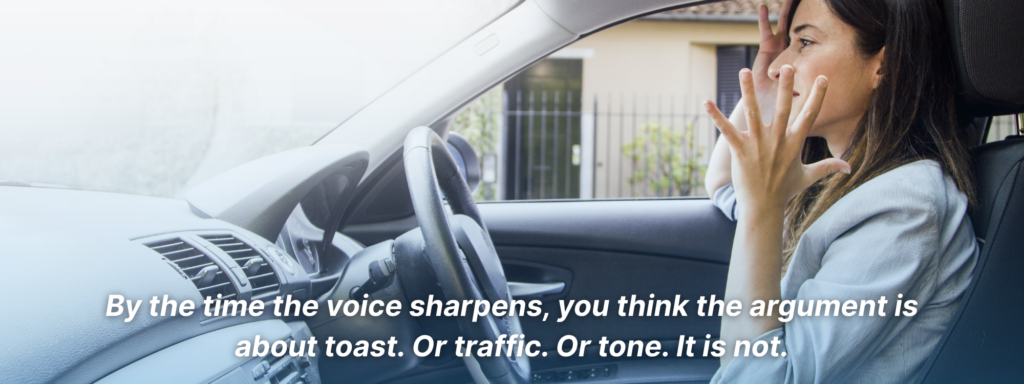
By the time the voice sharpens, you think the argument is about toast. Or traffic. Or tone. It is not. It is about the sentence that stepped in first and framed the room.
When the Lens Tightens
That sentence does something subtle and swift. It narrows the field. Once ‘here we go again’ has taken its place, you begin to scan for evidence. You do not notice you are doing it. You simply collect small confirmations. The sigh. The look. The phrasing. Each one folded neatly into the file marked ‘always’.
This is how the moment grows teeth.
It is not that the world changes. It is that the lens tightens. And when the lens tightens, your body follows. The shoulders brace. The breath shortens further. The voice gathers a shade more edge. You are now inside the sequel and wondering how it started so quickly.
At a party, the same sentence works a different shift. ‘I don’t belong here.’ It slips in before anyone has spoken to you. You feel the slight lift of your shoulders, the quick dart of your eyes. The room becomes an exam hall. You begin marking yourself harshly. Someone laughs across the room and you assume it is not with you.
Nothing has happened. And yet everything has tilted.
The sentence came first.
In traffic, it might be ‘people are idiots’. Efficient. Broad. Comfortingly sweeping. It spares you the labour of nuance. The driver in front hesitates for a second too long and your diagnosis is confirmed. The hand tightens on the wheel. The breath thins. The day loses a degree of patience.
Again, nothing dramatic. Just a sentence stepping forward and claiming the floor.
Hear It Before It Settles
We rarely question these lines because they feel like commentary. In truth, they are instructions. They tell the body how to prepare. They tell the eyes what to look for. They tell the voice how sharp to be.
And because they arrive so quickly, we mistake them for fact.
‘I can’t deal with this’ sounds like a description. It is often a decision.
This is not about pretending everything is fine. It is not about forced optimism or the sort of positivity that smells faintly of denial. It is about noticing that between the kettle and the argument, between the red light and the horn, between the party door and the retreat to the phone, there was a sentence.
Small. Private. Decisive.
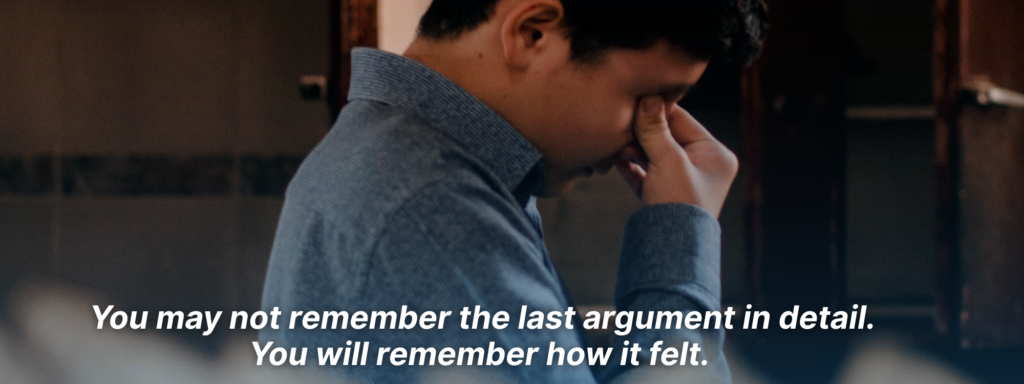
You may not remember the last argument in detail. You will remember how it felt. Tight. Fast. Inevitable.
What you probably will not remember is the quiet line that made it so.
That line is the real beginning.
And if you can learn to hear it as it lands, before it settles in and rearranges the furniture, you are no longer living one beat too late.