
Somebody in a meeting last month drew breath to speak and then didn’t.
You might have seen it. The small intake. The shift forward in the chair, weight moving onto the forearms. Then the settling back, and the face rearranging itself into something attentive. It takes about a second and a half, and it is the most common event in corporate life.
Whatever they had, you don’t have.
Afterwards there was the corridor. Two people who between them said nothing for fifty minutes, now talking with some heat about the thing that had just been decided. You know the meeting after the meeting. Most people have been in one, and a fair number have been the reason for one, though that part tends to arrive later and in private.
Watch a stretch of a few minutes rather than a single moment, because the mechanism shows up better in motion. Someone raises a worry they can’t quite name, something about the timeline, they’re not sure, it might be nothing. A senior person answers. The answer is quick, reasonable and entirely correct. The room moves on, faintly relieved. That person does not speak again for the remaining fifty minutes. Ask them about it in the lift and they will tell you it wasn’t worth raising, and they will mean it as a judgement about their idea rather than about the room.
Nothing rude happened. Nothing occurred that would show up in a note of the meeting. The minutes will record that a concern was raised and addressed, which has the advantage of being true.
The Price We Put on Speaking
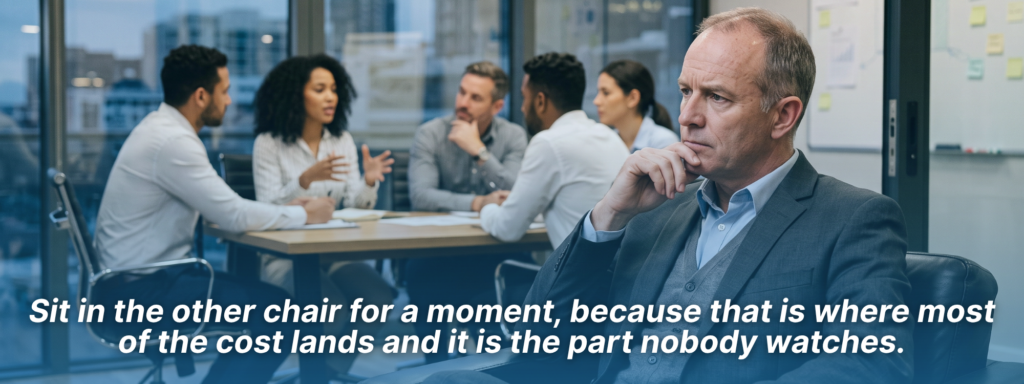
Sit in the other chair for a moment, because that is where most of the cost lands and it is the part nobody watches. You are holding something. Not a grand objection, just a thought that arrived slightly out of shape. You work on it while other people talk, sanding the edges, adding a qualifier so it lands more softly, deciding to wait for a natural gap and then deciding that gap wasn’t quite natural enough.
The meeting closes. The thought is still in your hands, noticeably smaller than it was an hour ago, and you carry it out into the corridor where you will spend it on somebody who can do nothing with it. Nothing was taken from you. You simply spent fifty minutes becoming a slightly quieter version of yourself, and the odd thing is that by Thursday you won’t remember it happening. It happens too often to remember.
You know the calculation from the inside too. There is a version you run in front of your own boss, the quick scan of who is in the room, what mood they walked in carrying, whether this is the week. It does not feel like fear. It feels like judgement. And it feels like reading the room, and reading the room is a skill, so on a good day it feels like competence.
When Speaking Starts to Cost More
And then there is one you will remember in some detail, because it happened to you rather than in front of you. Somebody brought you something expensive. A number that had been wrong for longer than anyone had owned up to. A client who had already decided and hadn’t mentioned it. A mistake with a name attached, and the name was sitting three feet away. Other people were present.
Whatever you did in the next thirty seconds you did in front of an audience, and you did it while still taking in the news itself. Most people can find two or three of those in a year, and can still name who else was in the room.
The hardest thing to notice is what stops arriving. The unprompted question. Bad news that comes early rather than on schedule. The idea offered before it was ready. When those thin out, nothing appears anywhere at all. Nobody files a report on a concern they decided against raising. The meetings run to time, the papers get approved, the reporting looks clean, and the whole thing has the pleasant appearance of a machine running well.
How People Learn the Price
There is a way to read all of this, and a way to test the reading against your own week.
Six scenes, and one thing sitting underneath every one of them.
Before anybody speaks, they price it. Not deliberately, and nobody experiences it as arithmetic. They estimate the cost of being wrong, or unwelcome, or merely half formed, in front of these particular people. And they do not take that estimate from the values statement or the leadership charter. They take it from what they have watched happen to other people who spoke.
The one with the half formed timeline worry learned something from a correct answer. Not that they were wrong. Something more useful to them, which is that unfinished thinking gets resolved at speed here. Cheap for the room to answer. Expensive to have offered. Which is exactly what they told you in the lift, in the language of whether it was worth it.
Notice how little force the mechanism requires. Nothing stopped them speaking again. No rule was made, nobody was reprimanded, there was no moment anyone would describe afterwards as unpleasant. The conditions changed and the willingness followed at its own pace. Which means the damage never appears anywhere near the cause. You will go looking for the decision that produced the silence, and there will not be one, and you will conclude that nothing is wrong.
Who Sets the Price
One bound on this, since it changes what you can reasonably expect of yourself. You are not the only one setting the price. Peers set it. The last round of redundancies set it and will go on setting it for a year or more, whatever the intranet says about renewal. So does whether somebody’s visa is attached to the role, or their mortgage repriced in March. You set a large share of it, and you are the only part of it you can move, which is an argument for attending to your share rather than for believing it is the whole.
The asymmetry is what keeps it out of sight. You only ever see what was said. You never see the alternative meeting, the one where the worry got three more minutes and turned out to be the delivery risk nobody caught. That meeting leaves no trace, so it cannot be added up, and what cannot be added up does not reach a board paper.

When Agreement Looks Like Alignment
And the last part is the reason it holds. A leader who believes the team is aligned attends to agreement. Agreement is what gets offered, because offering it costs nothing. The belief is then confirmed by conditions the belief itself produced. The loop closes, and from the inside it looks precisely like evidence, which is the most expensive optical illusion in the building.
You do not set the culture. You set the price.
If that is right, several things follow, and they are worth sitting with rather than skimming.
Why Connection Cannot Be Installed
The first is that connection cannot be installed. Offsites, charters, values on the wall, a programme with a name and a launch date. These are announcements, and an announcement is a cheap signal. It costs nothing to make, everybody knows it costs nothing, and that is exactly why it does not shift the estimate. Observed consequence is expensive, which is the whole reason it gets believed.
The second is that the price gets reset in a very small number of moments, and you have already met them. They are the two or three a year you can still describe: the expensive news, the audience, the thirty seconds. Those are the moments doing the work. Everything else is weather. Which is an uncomfortable ratio, because it means the quality of your leadership here is settled at the moment you are least composed and most closely watched, and no quantity of decent behaviour across the other fifty weeks buys it back.
The third is that you cannot manage this directly and you cannot measure it directly. There is no instrument for a question that was never asked. You can only read it in the negative, by noticing what has stopped arriving, which means the leaders most exposed to the problem are the ones least equipped to see it coming.
The fourth is awkward, and I would rather say it than steer around it. Everything above applies to frameworks, this one included. A model handed over as a finished object is another cheap signal. If any of this turns out to be worth something, it will be because it was recoverable from what you have already watched happen in your own meetings. If it isn’t, put it down.
When Frameworks Become Cheap Signals
For what it is worth, the research runs the same way, and it is worth having as confirmation rather than foundation. Amy Edmondson’s early work on hospital teams found that better performing nursing units reported more medication errors, not fewer. They were not making more of them. They were willing to say so. The reporting rate was measuring the price rather than the error rate, which is what you would expect if the mechanism above is real, and the wrong conclusion entirely if all you had was the dashboard.
What Psychological Safety Really Means
There is a name for the field this belongs to and I have kept it back until now: psychological safety. That was deliberate. The phrase has been worn smooth by use, and a reader who meets it in the opening paragraph stops watching their own meetings and starts remembering a training module with a slide deck. The whole thing depends on the watching. If the mechanism holds for you, it holds because you recognised it happening, and the literature is only a check that you weren’t imagining things.
Which leaves the question of what you would want instead.
Not a connected organisation. Connection is the mechanism rather than the goal, and organisations can be densely connected and comprehensively uninformed, as anyone who has worked in one will confirm.
What is worth wanting is an organisation that can still surprise the people running it.
That is the whole of it. Bad news arriving early, from below, unprompted, and slightly too raw to be comfortable. Somebody telling you the thing you would have preferred to hear next quarter. The reading you took last month turning out to be wrong, and you finding out from a person rather than a result. An organisation in that condition is not restful, but it is in contact with itself, and contact is the first thing the closed loop takes and the quietest thing to lose.
The Cost of Candour
There is a second reason, and it has nothing to do with what you find out.
The one sanding the thought down through fifty minutes is paying for the room’s comfort in a currency that shows up on no statement anywhere. They are becoming a smaller professional by increments too fine to feel, and they will do it again on Thursday, and inside a year they will describe themselves quite cheerfully as someone who picks their battles. Whatever the organisation failed to learn is a side effect. That is the thing itself.
There is an older word for what a room does to people when the price gets high enough, and it is not a generous one. It belongs to the room, though, and not to the person who went quiet in it.
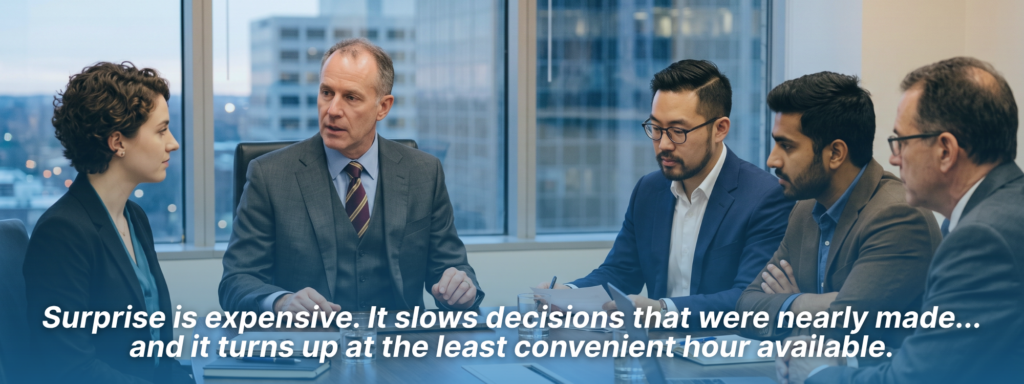
Two leaders can follow every step to here and disagree flatly about whether they want any of it, and that disagreement is real and should not be smoothed over. Surprise is expensive. It slows decisions that were nearly made, it costs you the authority of your last confident statement, and it turns up at the least convenient hour available. Wanting it is a choice about what you are prepared to pay for rather than a conclusion the facts force on you. Anybody who tells you the evidence leaves no choice is selling something.
Nor is it only expensive to you. Candour has an oversupply failure and it is just as real: places where every settled decision gets reopened, where transparency becomes the instrument for relitigating a loss, where nothing ever closes because closing it would mean somebody had been wrong. The cure for one condition is not the other one. What you are after is a price low enough that costly news travels, and high enough that it still counts as news when it lands.
From there the rest follows on its own.
Speak When It Matters
The principle is that you are accountable for the price of candour rather than for the quantity of connection. Connection is what happens once the price is low enough. It is not the thing you build. It is the thing that shows up.
Which gives you something sharp enough to use on a real decision. A choice is better to the degree that it lowers the cost of bringing you something you would rather not hear, and worse to the degree that it raises it. That applies to a restructure. It applies just as squarely to a performance conversation, a seating plan, and the tone of a reply sent at eleven at night.
The rule underneath it is that costly information does not get corrected on first contact.
In practice that means one behaviour. When somebody brings you something half formed, ask a second question before you offer a view, and hold to that most firmly when your answer is ready and right. The fast correct answer is the expensive one. It is the commonest way that thoughtful, decent people raise the price without once intending to, and it feels like being helpful the entire time.
Count What Reaches You
One thing to do this week, and it is not a programme. Name the last occasion somebody told you something you did not want to hear. Name what happened to them afterwards. Note who else was in the room to see it.
Then, for a month, launch nothing. Just count. Every time bad news reaches you early, unprompted, from somebody who did not have to bring it, mark it down. At the end you will have a number.
Be clear about what the number is not. There is no healthy figure anyone can hand you. Three would be a great deal in a team of six and nothing whatever in a division. A zero might mean a quiet month. It might mean the news is going to somebody else with more standing to hear it, and if that is what is happening it is worth learning who, because they are doing part of your job rather better than you are. The count does not measure the organisation. It measures what reaches you, which is the only part you can act on.
What the Number Tells You
So count twice. Run it again the following month, after a few weeks of asking the second question before offering the view. If the number does not move, then one of three things is true. The mechanism described here is wrong, or you are not the one setting the price, or you have not actually changed what you do. Each is worth knowing. None of them will announce itself.
But if it holds at zero across both months, and you know you changed, then the network is not quiet.
You are outside it.
Somewhere in a meeting this week, somebody will draw breath and then let it go. It will take about a second and a half. Nobody will write it down.
Your work was never to build the connections. It is to stop making them cost so much.