
Perfection looks like virtue from a distance. Up close, it looks like fear in a blazer.
It starts innocently enough. High standards. Pride in craft. A quiet intolerance for sloppiness. The sort of person who notices the crooked picture frame in a stranger’s house and feels personally obliged to straighten it, even though they do not live there and will never return. Organisations love these people. They ship work. They catch errors. They rescue meetings from drift. They make their leaders look competent.
And then, slowly then all of a sudden, they become the bottleneck.
Because perfectionism is not ‘quality’. Quality is a practice. Perfectionism is a mood disorder dressed as a performance metric. It is the belief that mistakes are not information, but evidence. Evidence that you are about to be found out, judged, excluded, demoted, mocked, or quietly replaced by someone younger who smiles more.
The tragedy is that perfectionists rarely announce themselves as perfectionists. They announce themselves as ‘accountable’. Or ‘professional’. Or ‘just wanting it to be right’. They speak in the language of excellence while their body speaks in the language of threat. Tight jaw. Shallow breath. Clenched shoulders. That hyper-vigilant scanning for what might go wrong, because what might go wrong feels like what will go wrong, and what will go wrong feels like what will happen to them.
If you lead a team, you have seen the pattern even if you have never named it. Work slows down just as deadlines tighten. People hesitate before offering ideas. Decisions get postponed until more ‘information’ arrives, which is another way of saying ‘until we feel safe’. Drafts circulate endlessly. Feedback becomes surgical. Meetings become theatre. Everyone agrees. No one commits. The product ships late, and when it ships, it is safe. Which is another word for ‘already obsolete’.

A Cultural Weather System
Perfectionism is not a personal quirk. It is a cultural weather system.
In some places, it grows because failure is punished. Not with formal discipline, but with the more corrosive social penalty: ridicule, exclusion, or the quiet downgrade of trust. In other places, it grows because leadership confuses criticism with rigour. They think they are sharpening the team, when they are actually teaching them to flinch. The team learns quickly. Do not show work until it is bulletproof. Do not ask questions until you already know the answer. Do not admit uncertainty. Do not be the one who takes a risk and becomes the story people tell at lunch.
The irony is that perfectionism masquerades as integrity while slowly hollowing it out.
Because the perfectionist, under pressure, stops telling the truth. Not in the dramatic, moustache-twirling way. In the small ways that matter most. They hide unfinished work. They inflate confidence. They downplay risk. They delay raising problems until the last possible moment, when it is too late to fix them without damage. They become a curator of appearances, not a steward of outcomes.
So when you say, ‘Teaching your team to fail well is more important than teaching them to be perfect,’ you are not being soft. You are being realistic. You are treating the team like a living system, not a factory.
Perfectionism: The Contrast With Failing Well
In living systems, failure is not the opposite of success. Failure is the feedback loop that prevents collapse.
A child learns to walk by falling. A team learns to ship by missing something, seeing the consequence, and adjusting. A leader learns to lead by misreading a room, repairing, and becoming more accurate. Without controlled failure, you do not get learning. You get compliance. And compliance is fragile. It holds until pressure rises, then it snaps.
The real question is not whether your team will fail. They will. The real question is whether they will fail early, small, and recoverably, or late, big, and publicly.
Failing well is a skill. It can be taught. It must be modelled.
It begins with a simple, unglamorous practice: naming reality without theatre. When something goes wrong, you do not hunt for villains. You look for signals. What was the assumption? What was missed? What changed? What did we learn? The tone matters more than the words. If your voice carries blame, people will hear blame even in a perfectly phrased question. If your voice carries steadiness, they will speak.
And then you make failure safe enough to be reported, but not so cosy it becomes recreational.
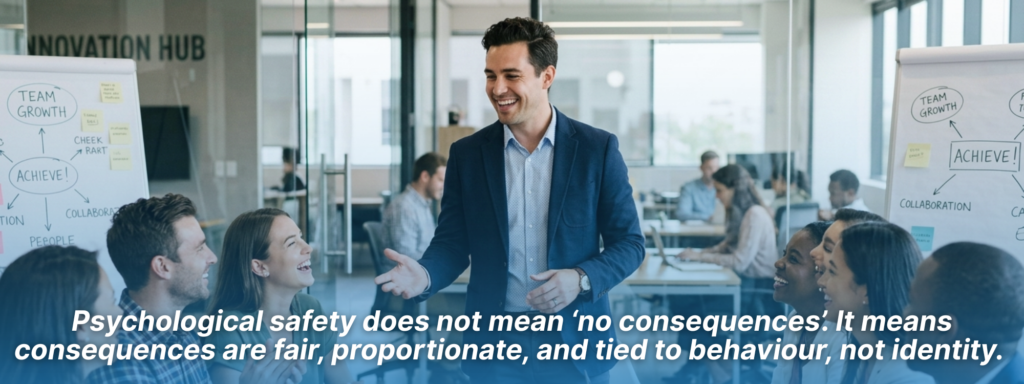
This is where leaders often get confused. Psychological safety does not mean ‘no consequences’. It means consequences are fair, proportionate, and tied to behaviour, not identity. It means people can say, ‘I got it wrong,’ without fearing humiliation. It does not mean they can repeatedly ignore standards and call it authenticity.
The standard remains. The difference is how you get there.
Perfectionism says: ‘Do not move until you cannot be criticised.’
Failing well says: ‘Move in smaller steps, sooner, where we can see what is real.’
Perfectionism prizes polish. Failing well prizes detection. The best teams do not avoid errors. They surface them early. They notice tiny deviations before they become disasters. They do not treat mistakes as moral failures. They treat them as information.
The Exhausting Physical Toll
There is another reason failing well matters, and it is the one nobody prints on the leadership poster. Perfectionism is exhausting.
A perfectionist’s nervous system lives in permanent readiness. It is not working on the task. It is working on the social threat wrapped around the task. The person is not just writing the report. They are trying to prevent the feeling of being judged. Not once. All day. For years. Eventually, they stop being brilliant and start being brittle.
Teaching people to fail well is, in part, teaching them to recover. To repair. To return to contribution rather than retreating into self-protection.
You do this by modelling your own fallibility without collapsing into melodrama.
You say, plainly, ‘I misjudged that. Here’s what I’m changing.’
You acknowledge errors early, before they become rumours.
You narrate course-corrections as normal leadership, not as confession.
You show that competence includes adaptation, not just precision.

Building Structures for Resilience
And then you build simple structures that make failing well the default.
You shorten feedback cycles. You encourage early drafts. You reward the person who flags a risk early, even when it is inconvenient. You set clear definitions of ‘good enough’ for this stage, and ‘excellent’ for the final stage, because perfectionists often treat every stage like it is the final.
You also get specific about what failure is allowed and what is not.
Allowed: a well-intentioned experiment that missed the mark, reported early, with learning captured.
Not allowed: repeated negligence, hidden errors, or blame-shifting disguised as ‘just being honest’.
The point is not to make failure harmless. The point is to make it useful.
Because perfection is a mirage. It keeps you chasing the horizon while the terrain beneath your feet changes. The team that worships perfection becomes slow, secretive, and afraid. The team that learns to fail well becomes fast, honest, and resilient. They do not panic when things go wrong. They adjust. They tell the truth sooner. They keep moving.
And that, in the end, is the difference between a team that looks impressive on paper and a team that can be relied on when reality shows up and starts throwing chairs.
Perfection will always feel like safety. That is its seduction. But in real work, under real constraint, the safer team is the one that can trip, curse quietly, get up, and keep going, without turning the stumble into a funeral.
Teach that. Reward that. Model that. And you will get something far better than perfection.
You will get a team that learns.