Freedom is a word that expands as it is uttered. It conjures open horizons, unmarked paths, the sense that one might step in any direction without resistance. It is invoked in boardrooms and parliaments, in classrooms and campaign speeches. As though choice were a wide plain and not a fenced field, we say:
‘We are free to choose’
Then reality intervenes. Budgets are finite. Time is limited. Bodies age. Markets fluctuate. Colleagues resist. Gravity remains stubbornly in force. The plain turns out to be mapped by constraints long before we arrive.
For some, this discovery feels like insult. If we are shaped by biology, influenced by culture, nudged by incentives and boxed in by circumstance, what becomes of freedom. Are we merely reacting to forces beyond our control. Is human agency an illusion, a decorative word attached to inevitable outcomes.
This is the wrong question. The right question is not whether we are unconstrained. It is whether we can act intelligently within constraint.
Total freedom has always been a fantasy. Even the most independent entrepreneur operates within markets, laws and the physics of production. Even the most rebellious artist relies on language inherited from predecessors. Likewise, even the most decisive leader depends on the cooperation of others.
Constraint is not the enemy of agency. It is its context.
Human Agency Within Constraints
Imagine a river. It does not resent its banks. Without them it would be a flood. The banks give it direction. Within those limits it gathers speed, carves valleys, shapes landscapes. Its power emerges not from the absence of boundary but from the interaction with it. Human agency operates similarly.
Biology constrains us. We require sleep and we tire. We respond emotionally to threat and reward. Culture constrains us. We inherit norms, expectations, stories. Institutions constrain us. We answer to regulations, contracts, hierarchies.
Pretending these constraints do not exist produces poor decisions. A leader who ignores resource limits overcommits. A manager who disregards cultural norms misjudges response. An individual who denies physical limits burns out. Freedom without realism is delusion. Freedom with realism is leverage.
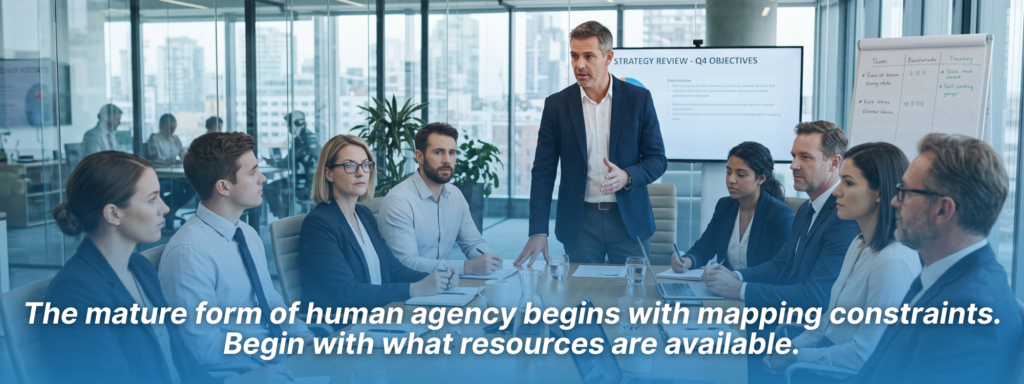
The mature form of human agency begins with mapping constraints. Begin with what resources are available. What incentives are in play. What patterns recur. And what habits shape reaction. This mapping is not defeatist. It is preparatory. Once constraints are visible, options become clearer.
Consider a team under tight budget pressure. One approach is to lament the restriction, to demand impossible expansion, to frame every compromise as betrayal. Another approach is to examine the constraint creatively. Where can processes be streamlined. Which activities produce the most value. How might collaboration offset scarcity.
The budget does not vanish. The response becomes strategic.
Seeing Constraints as Strategic Advantage
On a personal level, the same logic applies. If you know that fatigue makes you impatient, you can schedule difficult conversations earlier in the day. If you recognise that social approval influences your decisions, you can pause before aligning reflexively. Awareness of influence does not negate choice. It enhances it.
Agency without illusion accepts that choices occur within systems.
This perspective also softens moral judgement. If behaviour is shaped by context, altering context becomes as important as exhorting willpower. Leaders who understand this design environments that support better decisions. Such leaders align incentives. They simplify procedures. They anticipate error rather than condemning it.
Such leaders do not absolve individuals of responsibility. They recognise that responsibility is exercised within structure.
The Humility That Strengthens Leadership
There is a humility in this stance. It rejects the grandiose narrative of the solitary hero who bends reality to desire. It replaces it with the image of a skilled navigator reading currents and wind.
Navigation requires attentiveness. It requires adjustment. It requires acknowledging forces stronger than oneself.
The paradox is that this humility increases practical power.
When you accept that markets shape demand, you study them. When you accept that bias shapes perception, you build checks into decision-making. And when you accept that emotion influences judgement, you cultivate regulation rather than denial.
The fantasy of unconstrained freedom leads to brittle leadership. It produces bold declarations unsupported by capacity. It collapses under friction.
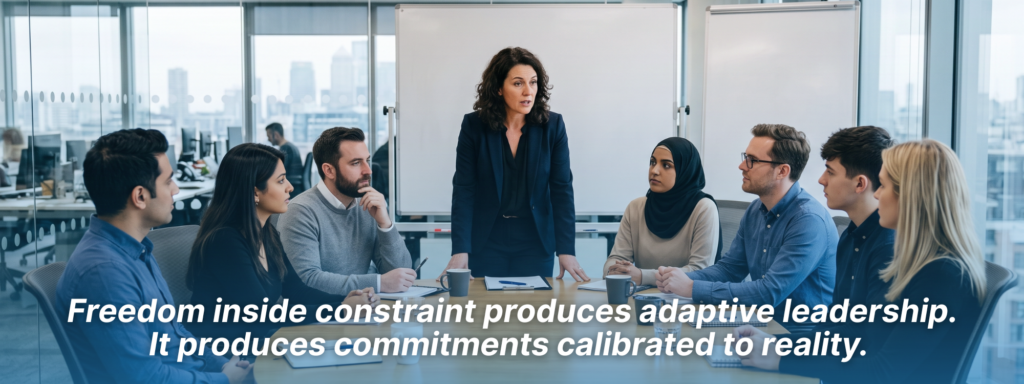
Freedom inside constraint produces adaptive leadership. It produces commitments calibrated to reality. It produces resilience because plans account for resistance rather than assuming compliance.
There is also a psychological benefit. Letting go of the illusion of total control reduces anxiety. You are not responsible for eliminating every obstacle. You are responsible for responding intelligently to those that exist.
This shift transforms setbacks. Failure becomes information about constraint rather than evidence of personal inadequacy. Success becomes alignment with conditions rather than proof of omnipotence.

Where Real Freedom Begins
In teams, acknowledging constraint fosters honesty. Instead of pretending that targets can be met regardless of context, leaders can say, ‘Given these limits, here is what is achievable’. This transparency builds trust. It prevents the corrosive cycle of unrealistic demand followed by predictable disappointment.
Freedom then becomes something precise. It is the capacity to interpret conditions accurately and act effectively within them. Equally important is the ability to revise strategy when feedback contradicts expectation. It is the courage to choose among imperfect options rather than fantasising about perfect ones.
This is not a smaller freedom. This is a more durable one. It does not rely on denial. It relies on awareness. The open horizon remains a powerful metaphor. But even horizons are bounded by the curvature of the earth.
Agency flourishes not in the absence of limit, but in the intelligent engagement with it. Recognise the banks. Read the current. Adjust the course. The river does not need to escape its channel to shape the land.
Nor do you.