
Nervous System Shapes Leadership Presence
Leadership begins long before language. Long before a plan is drawn, or a sentence framed, or a strategy polished into something presentable for a board that pretends not to be bored. Leadership begins in the body. In the twitch of a jaw that gives away impatience. In the breath that steadies a room. In the fractional lift of an eyebrow that tells a team: we’re not lost, not yet. No one teaches this in business school. They should. Most of what people call “presence” is simply a nervous system doing its job with a bit of grace.
It’s an inconvenient truth, of course. Executives prefer their leadership like their spreadsheets: clean, numerical, predictable. But the body refuses to be managed like a cost centre. It reacts, signals, anticipates; it leaks truth even when the owner is determined to project something more heroic. In a world drowning in metrics, the nervous system remains stubbornly analogue, and infuriatingly accurate.
You already know this. You’ve walked into rooms where the air seemed to tighten for no good reason. Someone’s shoulders were too high. Someone else’s eyes were moving too fast. A third person’s silence wasn’t reflective; it was tactical. No words were spoken, yet the meeting’s future had already been written. The body always speaks first. And leaders forget this at their peril.
Using the Nervous System With Deliberate Agency
Permission → So let’s start with the simplest admission: your nervous system is not a private experience. You may live inside it, but everyone around you is reading it like commuters scanning a timetable. They want to know if it’s safe. They want to know if you’re steady or spiralling. They want to know whether they should lean in, step back, or brace. Leadership is, at its core, the art of becoming readable in ways that help others settle rather than scatter. Before you impress, you must regulate.
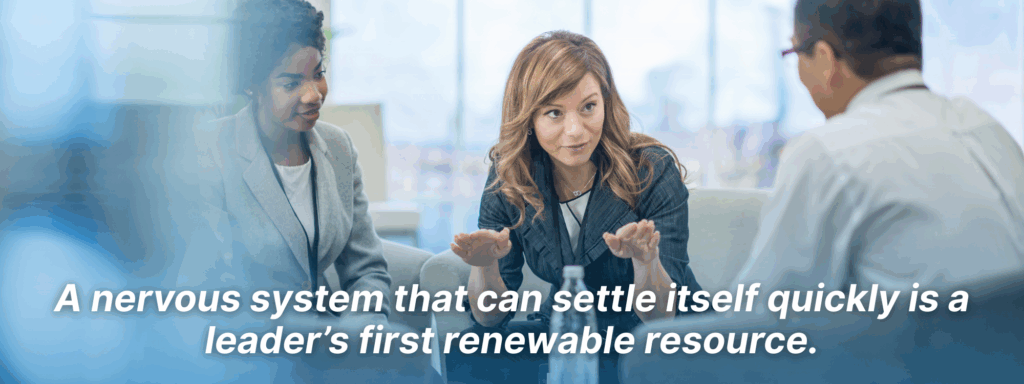
There’s a certain liberation in that. It frees you from the exhausting performance of pretending to be invulnerable. Steadiness isn’t stoicism. It’s the quiet discipline of knowing what state you’re in before the room pays the price for it. A nervous system that can settle itself quickly is a leader’s first renewable resource. Not because calmness is virtuous, but because it’s contagious. Humans tune to each other the way instruments do: the least stable one pulls the rest off-key.
Agency → Once you accept that your body is conducting the room whether you intend it or not, you can begin to use it with deliberation. This is where leadership stops being mystical and becomes mechanical. How you stand shapes how you think. How you breathe shapes how you decide. How you direct your attention shapes what the room believes is important. Agency begins the moment you realise the feedback loop goes both ways: you influence your body, and your body influences your people.
Consider the small calibrations. A stance grounded through the feet communicates commitment. A jaw released communicates willingness. A voice that pauses half a second longer than normal communicates authority without aggression. These aren’t tricks. They are micro-signals of a nervous system that has upgraded from “reactive organism” to “deliberate instrument.” Your team may not consciously notice, but they feel the difference, and they behave accordingly.
This is why two leaders can give the same instruction and only one gets results. Followers don’t respond to what you say; they respond to the residue of state carried in how you say it. A steady nervous system makes clarity contagious. A scattered one makes confusion inevitable.

Tool for Connection and Safety
Connection → Then comes the part most people skip: using your nervous system to create the conditions in which other people can think. Not perform. Not comply. Think. A leader who can regulate themselves under pressure gives an unspoken permission slip for others to bring their best selves to the table. This is the quiet work of engagement: not rallying people with slogans, but steadying them by example.
Audiences, teams, and stakeholders all sense whether your presence is safe to approach. A regulated leader becomes a kind of human landing zone. People can bring dissent without being punished. They can bring uncertainty without being shamed. They can bring ambition without being mocked for wanting too much. This is how psychological safety actually works: not as a policy, but as a physiological transmission.
Curiously, once people feel safe, they do something delightful: they become useful. They stop armouring. They start speaking. They volunteer insights that weren’t on the agenda. They correct assumptions you didn’t realise you were making. They collaborate without being nudged like cattle between gates. Underneath every performing team is a leader whose nervous system is doing subtle, trustworthy work.

Embedding → And then comes the part that turns this from a good idea into a professional discipline: repetition. A nervous system becomes a leadership tool only when it becomes predictable. Anyone can regulate themselves on a good day. But a leader earns credibility by doing it on the bad days. On the days when the numbers are ugly, the politics are ugly, and the future feels like a coin toss with a sharp edge.
This is where embodied leadership becomes strategic. The nervous system that has rehearsed steadiness can deploy it under fire. The one that hasn’t will show its seams. And people notice. They always notice. Teams will forgive almost any mistake except the one that makes them feel unsafe. Safety is the currency that buys you the right to lead them through uncertainty.
Your nervous system will not fix broken strategy, or compensate for incompetence, or rescue you from decisions you should never have made. It’s not magic. It’s infrastructure. It’s the stabilising architecture that allows everything else to work: vision, persuasion, alignment, and execution. And like all infrastructure, it must be maintained.
So treat your nervous system as the leadership instrument it is. Tune it. Train it. Notice it. Use it deliberately. Because long after people forget your slides, your slogans, and your clever metaphors, they will remember one thing: how it felt to follow you.
And that feeling began in your body, not your words.