Logical Limits
We live in an age that reveres reason. Rationality, logic, and data-driven decision-making are the currency of expertise. Yet, time and again, individuals in high-stakes environments—pilots, emergency responders, elite athletes—credit their success to something else: instinct.
Take the case of pilot Chesley “Sully” Sullenberger, who landed US Airways Flight 1549 on the Hudson River. In those critical seconds after bird strikes disabled both engines, there was no time for calculations or deliberation. His instincts, refined through decades of flying, guided his actions, saving 155 lives.
What do these moments tell us? That reasoning, while invaluable, is not always fast enough. Instinct is what steps in when there is no time for conscious analysis. The problem is that many of us have been trained to distrust it.
Instinct’s Evolution
Instinct is not magic; it is a biological intelligence honed by millions of years of evolution. Our ancestors who ignored the “bad feeling” before stepping into an unknown cave did not survive to pass on their genes.
Neuroscientist Antonio Damasio’s research on patients with damaged emotional processing areas found that without emotion—without the intuitive “gut feeling”—people struggle to make even the simplest decisions. Why? Because logic alone is paralysing. It presents options but does not weight them in a way that feels meaningful.
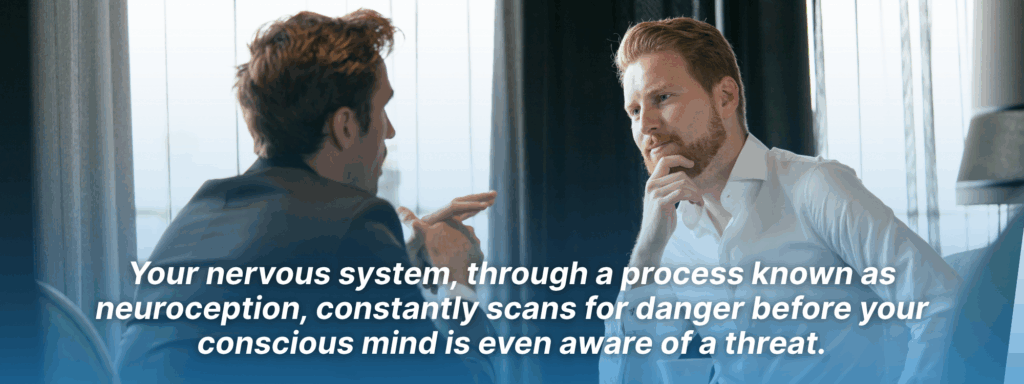
Your nervous system, through a process known as neuroception, constantly scans for danger before your conscious mind is even aware of a threat. This is why your body tenses before you even realise you’ve heard a strange noise in the dark. It is why elite firefighters sense when a building is about to collapse before there are visible signs. Their bodies detect subtle cues—the heat of the floor, the behaviour of the flames—that their conscious minds have not yet processed.
When Instinct Fails
However, instinct is not infallible. It can be distorted by fear, past trauma or innate bias. For instance, availability bias—our tendency to overestimate risks that are easy to recall—can make us misinterpret harmless situations as threats. The nervous flyer feels a sudden jolt of turbulence and instinctively panics, though logically they know the plane is fine.
This is where reason must re-enter. The goal is not blind trust in instinct, nor blind trust in reason, but an integration of the two.
Instinctual Acuity
If instincts are sometimes unreliable, should we discard them? No. Like any skill, instincts can be trained and refined. Studies show that decisions are felt in the body before they reach the conscious mind. The ‘Pause & Tune-In’ exercise is quick, easy and begins to refine your ability to dial into your instincts:
- So long as its is physically and socially safe, you may want to close your eyes.
- Begin with slow, deep breaths to settle your mind.
- Move your awareness through your body, scanning for tension, warmth, or discomfort.
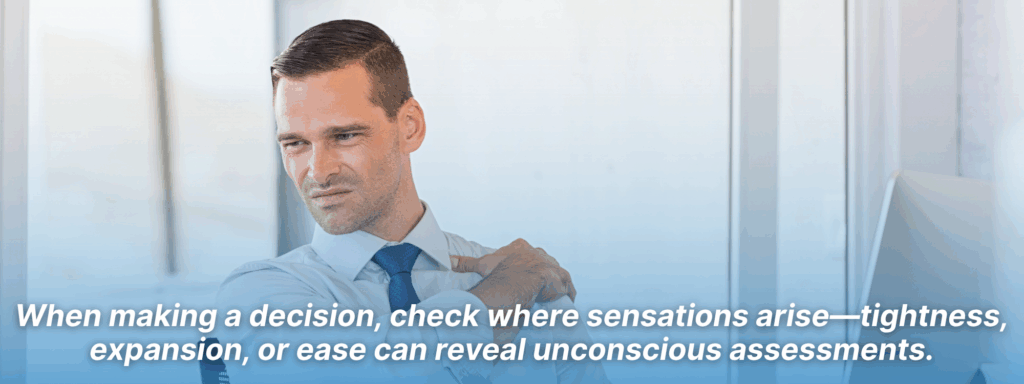
- When making a decision, check where sensations arise—tightness, expansion, or ease can reveal unconscious assessments.
Here are three easy-to-learn, highly effective techniques, which are fully explored in, ‘Neuro-Resilience Skills: How Leaders Conquer Stress & Builds Unflappable Teams’. These skills ensure your intuition is honed, refined and working for you:
- Somatic Honing – Dials up awareness of unconscious physical decision signals.
- Dual-Mind Reflection – Balances instinct and logic for sharper decision-making.
- Decision Journaling – Tracks fast- and slow-thinking patterns for better results.
Instinct-Intellect Blending
Instinct provides the spark; intellect provides the framework. The greatest decision-makers—whether in business, science, or combat—are those who learn to trust the whisper while using reason to interpret it.
Consider Albert Einstein’s approach to physics. His breakthroughs were not purely deductive; he often spoke of visualising ideas as intuitive images first. Only later did he translate them into mathematics.
Likewise, the best strategists in war—from Napoleon to Sun Tzu—describe victory as an art, not just a science. They could sense a battlefield’s dynamics before their subordinates could explain them.
Courage to Listen
Trusting instinct requires courage. It means acting without perfect proof, without the assurance that logic can provide. But some of the most transformative decisions in history have been made this way.
- Steve Jobs ignored market research that said touchscreen phones wouldn’t sell. His gut told him otherwise.
- Marie Curie pursued radioactivity when others dismissed it as a curiosity.
- Rosa Parks refused to give up her seat—not because of logic, but because something deeper in her said, “Enough.”
When instinct and intellect work together, they produce breakthroughs.

The Whisper Within
Instinct is not a relic of a primitive past; it is an advanced survival mechanism. The difference between those who succeed and those who hesitate is that the former listen, refine, and act. So, the next time you feel that quiet, inexplicable pull—pause. Test it. Train it. Trust it.
Because sometimes, what your instincts whisper today is what your intellect will understand tomorrow.