
No one blamed him at first. A nice man, they said. Always willing to help. Carried himself like the sort who’d hold the lift for you even if you were still halfway down the corridor. A model of cooperation in a company that prided itself on teamwork, though that word had been stretched to cover everything from genuine collaboration to passive-aggressive committee meetings where enthusiasm went to die.
He said yes to everything. Extra projects. Last-minute deadlines. Covering for colleagues who mysteriously ‘forgot’ annual leave requests until the day before flying to Bali. If there was a volunteer needed, his hand went up as though pulled by invisible string. And for a while, people applauded. Senior leaders praised his commitment. Peers admired his work ethic, though some with the faintly embarrassed tone of those watching a street performer juggle chainsaws: impressive, but you didn’t want to stand too close.
But the thing about never saying no is that eventually you run out of yeses.
The Slow Creep
It didn’t happen dramatically. No single moment where the whole thing collapsed in operatic style. Just the slow creep of exhaustion disguised as diligence.
Deadlines started slipping. Not badly at first, just enough for people to notice emails arriving at 2am with cheerful subject lines that fooled no one. Meetings saw him smiling a fraction too long before answering, the mental equivalent of spinning beach balls on a frozen laptop.
But he kept saying yes, because by now he couldn’t imagine another option. He’d built a reputation on availability; saying no might look like weakness, or worse, selfishness.
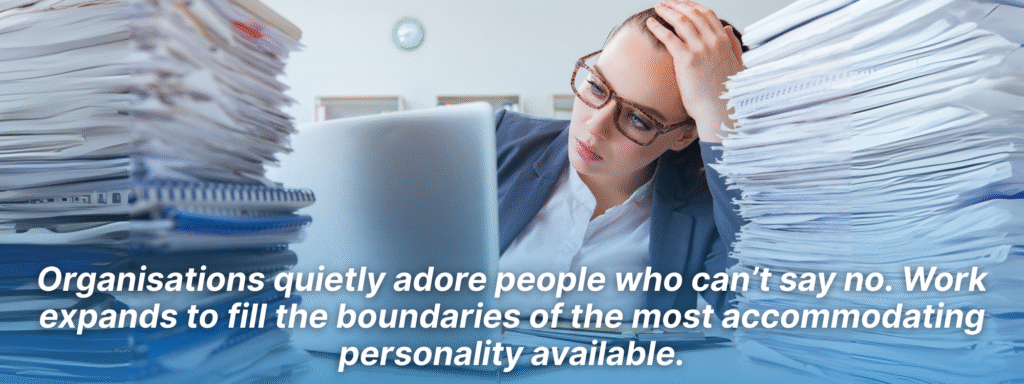
And that’s the trap. Organisations quietly adore people who can’t say no. Work expands to fill the boundaries of the most accommodating personality available. As long as someone keeps absorbing it, no one above has to confront whether the volume itself makes sense.
The Cracks Beneath the Politeness
Colleagues started adjusting around him, as people do around slow-moving traffic. They stopped expecting him at Friday drinks. He was too busy. They stopped asking his opinion on projects not already assigned to him. Too stretched. Too distracted.
He was still unfailingly polite, of course. Smiled in corridors. Asked about weekends he no longer had time to enjoy himself. But people sensed the withdrawal beneath the manners — the slight delay before laughter, the faraway look when others brainstormed ideas he’d inevitably end up executing alone at midnight.
Teams read these cues long before managers notice them. The silence after he spoke in meetings. The way no one asked if he needed help because they already knew he wouldn’t say yes even if he did.
Why Leaders Let It Happen
Partly because he made things easier. No need to reassign work or face awkward capacity conversations while he kept nodding along like a dashboard ornament. His line manager probably half-suspected the problem but said nothing. After all, the outputs kept arriving. Sort of.
And partly because organisations love the story of the tireless worker. Always available, always agreeable, carrying half the company on their back while senior leaders give keynotes about resilience and work-life balance from hotel stages.
Saying no would puncture that story. It would require someone to point out that unlimited availability isn’t a virtue; it’s a slow form of organisational self-harm.

The Cost of Yes
Eventually, things cracked. They always do. A missed deadline snowballed into a client issue. An oversight in a rushed report embarrassed someone important enough to notice. The same leaders who once praised his commitment now questioned his reliability, as though the two weren’t joined at the hip.
That’s the thing about constant yeses: they hide the cost until it arrives with interest. Creativity dies first — no time for thinking when you’re sprinting through tasks like a waiter in a farce carrying too many plates. Then judgement goes, because decisions need oxygen and there isn’t any left. Finally health takes the hit: sleep, humour, perspective — all the things that stop work feeling like drowning in slow motion.
And, of course, the organisation loses too. Because burnt-out managers don’t mentor teams, don’t spot risks early, don’t innovate beyond the next deadline. They become bottlenecks wrapped in good intentions.
Learning to Refuse
The turnaround, when it came, wasn’t cinematic. No dramatic speech, no table-thumping declaration of boundaries. Just a conversation with a coach who asked a question no one in the company ever had:
‘What would break if you said no?’
He didn’t know. Had never tested it. Turned out the answer was: very little. Some deadlines shifted. Some colleagues grumbled before adjusting like grown-ups. A few projects went to people perfectly capable of handling them. The world kept turning, minus the 2am emails.
Saying no, he discovered, wasn’t rejection. It was clarity. It separated what mattered from what merely shouted the loudest. It gave his yes back its value. Because a yes means nothing when you offer it to everything.

The Wider Lesson
For leaders, the story lands close to home. Teams copy what they see. A manager who can’t say no breeds cultures where overload looks normal and exhaustion looks inevitable. Boundaries aren’t selfish; they’re infrastructure.
The best leaders model discernment. They teach teams to weigh requests against capacity, strategy, and sanity rather than reflexively absorbing whatever rolls downhill. They know every no protects the meaning of the next yes.
Because organisations always have more ideas than attention, more projects than people, more ambition than hours in the week. Someone has to decide what doesn’t get done, or everything gets done badly.
He learned, slowly, that no is a leadership word. It signals priorities. It creates space for thinking instead of scrambling. It keeps teams human in places that would otherwise run them like software until something crashes.
And the first no, spoken out loud after years of yes, didn’t break anything at all. Except, perhaps, the habit of drowning politely.