
Elusive Power of Poise
The meeting was on the verge of collapse. Tension crackled through the air, an invisible current that had turned the boardroom into a battlefield. Voices overlapped, chairs scraped against the floor, and frustration boiled over into sharp retorts. And then—one person spoke. Slowly, deliberately, without raising their voice. The effect was immediate. The noise receded, drawn into the stillness like a tide obeying the moon. The shift was imperceptible at first, but within moments, the storm had passed. Calm had reasserted control.
The ability to command a room is not about force. It is not about the volume of one’s voice or the weight of one’s title. It is about presence—the kind of presence that speaks before words are even formed. Leaders who master this art wield an unspoken authority, one that is rooted in neuro-resilience and emotional regulation rather than in hierarchy or dominance. Their composure acts as an anchor, stabilising those around them, shifting the very dynamics of the space they occupy.
Grounded Gravitas
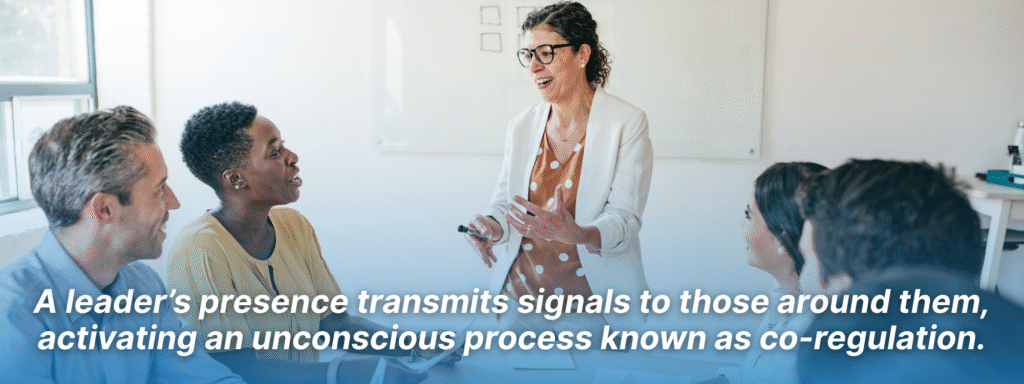
We are wired to seek stability in times of uncertainty. A leader’s presence—how they move, how they breathe, how they hold themselves—transmits signals to those around them, activating an unconscious process known as co-regulation. When someone exudes steadiness, their physiology influences others, guiding them towards calm. This is not metaphorical; it is biological.
Stephen Porges’ work on neuroception reveals that the human nervous system constantly scans for signs of safety or threat. In a meeting, a negotiation, or a crisis, this silent scan determines who will be followed and who will be ignored. If a leader exhibits stress—clenched jaw, shallow breathing, darting eyes—the group will register that tension and mirror it. But if a leader radiates calm, their stillness acts as a counterweight, pulling others back from the brink of reaction and into a state of control.
This is why the calmest person in the room controls the room. Not through intimidation, but through the invisible mechanics of human biology.
Metabolic Congruence
Calm is not a facade; it is a state of being. It cannot be faked convincingly for long because the body betrays internal tension through micro-signals—subtle flickers of muscle tension, erratic eye movement, changes in vocal tonality. Leaders who cultivate true composure operate from a place of metabolic congruence, where their internal state aligns with the external demands of their environment.
Neuro-Resilience Skills explores this phenomenon in depth, particularly in its technique Finding Home—a powerful approach for resetting emotional balance and returning to a state of calm. In high-pressure situations, where emotions run high and clarity is easily lost, mastering the ability to return to this baseline state ensures a leader remains in control. And for those moments when fear grips too tightly, when uncertainty clouds judgment, Stepping Out of Fear provides a critical pathway to regain perspective, creating the necessary distance to restore clarity and purpose.
Once this inner balance is achieved, the effect is instantaneous. People sense it. They respond to it. The tension in the room shifts, and without a single command being issued, the leader has established control.

Calm Control
One of the most effective tools a leader possesses is the ability to pause. When chaos erupts, when pressure mounts, when a conversation teeters on the edge of hostility—the leader who can pause without fear creates space for clarity to emerge.
In Neuro-Resilience Skills, Finding Home teaches leaders to resist reactive impulses and instead take a deliberate breath before responding. This pause serves two purposes: first, it disrupts automatic fight-or-flight reactions, allowing the prefrontal cortex to reassert control; second, it signals to others that there is no need for urgency or panic. It is a silent reassurance that rational thought is in play.
Consider the most revered leaders in history. The ones who stood firm in crisis. They did not react—they responded. Their measured stillness in the face of adversity made them a gravitational force, one that people turned to instinctively. The pause was their unspoken weapon.
Micro-Skills
Words are often unnecessary when presence is strong enough. Non-verbal congruence is a concept explored deeply in ‘Neuro-Resilience Skills’, where a leader’s body language is examined as a primary instrument of influence. The leader who stands grounded, breathes deeply, and moves with intention sends a powerful message: I am in control. This space is under my influence.
Compare this to a leader who fidgets, who rushes their words, whose movements are jerky and unsettled. The message—consciously or unconsciously received—is the opposite: This space is unstable. Chaos is in charge.
When words and body language align, influence is effortless. When they conflict, authority is undermined. This is why those who master non-verbal acuity find themselves commanding rooms without effort, their very presence acting as a stabilising force.

Emotional Contagion
Leadership is an inherently emotional act. People do not follow logic; they follow certainty. In moments of stress, humans instinctively look for someone who appears to have control. If they find that person, they will align with them emotionally and cognitively. This process, known as emotional contagion, explains why a single leader’s presence can shift the entire tone of a room.
But with this influence comes responsibility. Leaders must be mindful of the signals they project. If they allow themselves to be overwhelmed by frustration, that emotion will ripple outward, infecting the entire group. If they display certainty and composure, they will stabilise even the most volatile environments.
Skills not Traits
The ability to remain calm under pressure is not an inherent trait—it is a skill, one that can be developed and refined. Throughout ‘Neuro-Resilience Skills’, the explanations and practice offer leaders practical methods for conquering stress and building unflappable teams. Finding Home and Stepping Out of Fear are two out of over forty cutting-edge frames, tools and techniques which provide structured approaches to maintaining psychological and physiological equilibrium.
These skills are not about suppressing emotion but about mastering it. It is about recognising the body’s instinctual responses and learning how to shape them, so that in high-pressure situations, the leader is not fighting against their own physiology but working in harmony with it.
Final Thoughts
In any room, in any crisis, in any high-stakes conversation, the person who remains calm wields the true power. Not because they demand it. Not because they impose it. But because human biology dictates that we look to those who offer stability.
To command a room, to earn trust, to guide teams through uncertainty—leaders must become the still point in the storm. They must train themselves to be the steady presence that others can rely on, not through force or authority, but through the quiet, undeniable power of composure.
The calmest person in the room does not just control the room. They define it.