Gradual Then Suddenly
The moment a leader begins ignoring the stress in their body, they begin forfeiting their leadership. The descent is never immediate. It starts in increments—an unacknowledged headache that tightens into a perpetual vice, a sleepless night that turns into weeks of dull fatigue, a minor hesitation in speech that solidifies into chronic self-doubt. And yet, despite these warnings, many leaders press forward, determined to will themselves into resilience. But the body keeps score, and leadership is a game played in flesh and bone as much as in words and decisions.
In the high-stakes arena of leadership, stress is the invisible undercurrent shaping presence, clarity, and authority. Those who master their own neuro-resilience—who listen, adjust, and recalibrate—stand unshaken in the storm. Those who ignore it find themselves compromised, not by external forces, but by their own neglected biology.
Subtle Erosion
It never begins with a collapse. Stress does not announce itself with fanfare. It creeps. The leader who was once sharp and attuned now experiences the slow dulling of perception. A snap judgement that would have once been precise becomes riddled with second-guessing. A misread facial expression triggers defensiveness instead of curiosity.
Confidence, once effortless, now requires summoning. These are not mere inconveniences; they are the warning signs of a system under siege. Like a bridge under constant strain, stress fractures appear long before collapse. The structure holds, but barely. Leadership under pressure follows the same pattern—until one day, it gives way.
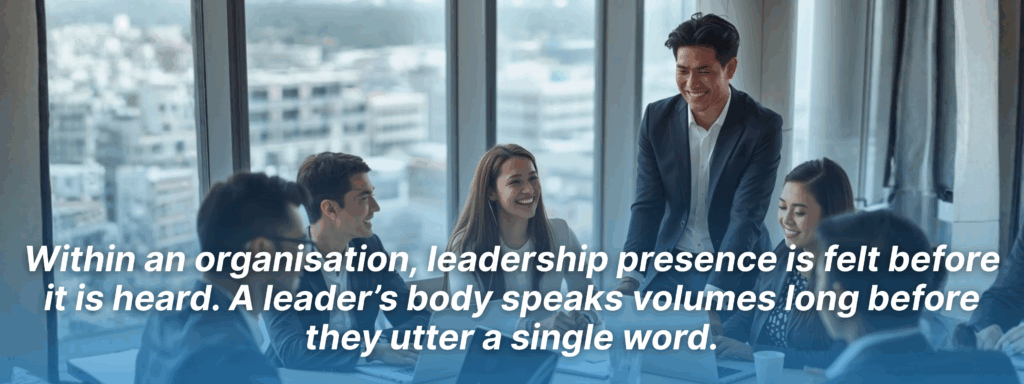
Within an organisation, leadership presence is felt before it is heard. A leader’s body speaks volumes long before they utter a single word. Their breath, their posture, the micro-muscular shifts in their face—teams respond to all of it, even if unconsciously. When stress takes hold, it warps these signals. A leader’s calm becomes brittle. Their composed stillness transforms into something taut and constrained. The result? A workforce that mirrors this instability. Stress, when ignored, is contagious.
The Body as Barometer
To lead effectively, one must first lead themselves. This means recognising the body as the first messenger. Fatigue is not laziness; it is a demand for recalibration. Tight shoulders are not an inconvenience; they are a sign of tension demanding release. A short temper is not a flaw in character; it is an overstimulated nervous system crying out for relief. The best leaders listen to these cues, not as distractions, but as direct intelligence about their own operational state.
Consider a CEO in the throes of an organisational crisis. The pressure to perform is immense. They enter a high-stakes meeting, determined to exude confidence. Yet their body betrays them. The tightness in their chest constrains their breath, making their voice slightly sharper. Their posture, instead of conveying authority, projects strain. The team senses it, even if they cannot articulate it. Trust weakens. The room becomes tenser. All because the leader ignored what their body was whispering all along.
Neuro-Resilient Leaders
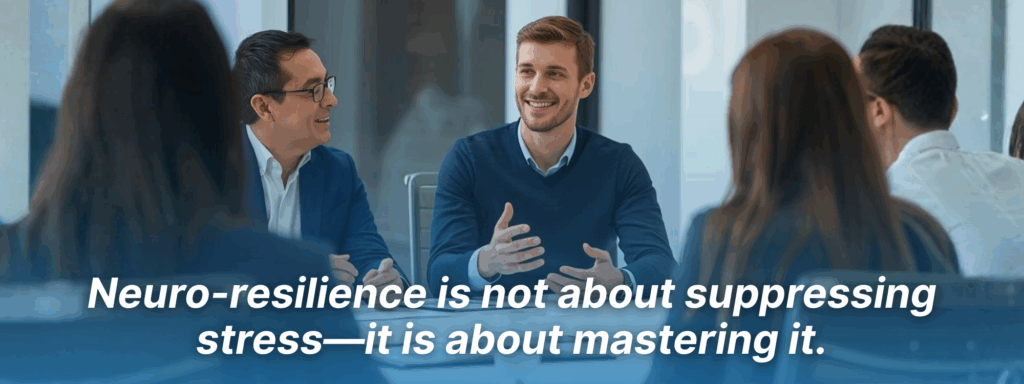
Neuro-resilience is not about suppressing stress—it is about mastering it. The leaders who thrive are those who understand that regulation begins from within. The key is not endurance, but recalibration. Those who dominate under pressure do so because they integrate techniques that allow them to reset.
In Neuro-Resilience Series, Paul O’Neill highlights several techniques designed to strengthen leadership presence by engaging the nervous system directly. Among them, Silencing the Storm and Turning Anxiety Around offer structured ways to recalibrate under pressure. They are not about escape, but about regaining control—because true leadership is the ability to remain centred while others unravel.
Silencing the Storm teaches leaders how to use advanced skills to regain mental control when stress, fear, and anger threaten to overwhelm. In the midst of conflict or high-stakes pressure, leaders who apply this method learn to shift from reactivity to deliberate response, ensuring their decisions and interactions remain sharp and purposeful.
Turning Anxiety Around serves a different but complementary function. Anxiety is often a by-product of a misaligned neurological response—one that, when understood, can be rechannelled into clarity and action. This technique helps leaders tap into their unique neurological patterns, allowing them to move from paralysis into purposeful momentum. It is not about ignoring anxiety, but about transforming it into a tool for focus and control.
By mastering these techniques, leaders move beyond crisis management into sustainable command. Stress becomes fuel, not friction. Leadership stops being reactive—it becomes inevitable.
Reclaiming Leadership
A leader who integrates these principles does not merely survive under stress—they transform it into fuel. They understand that self-awareness is not a luxury; it is an operational necessity. They do not wait for stress to accumulate into crisis; they attune to the subtle signs long before breakdown occurs. When stress rises, leadership falls. Unless.
Unless the leader listens. Unless they recalibrate. Unless they master the unspoken language of their own biology.
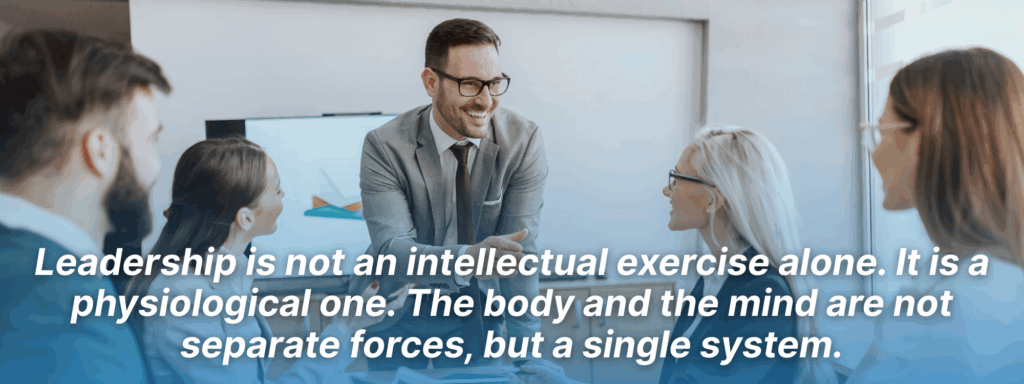
Leadership is not an intellectual exercise alone. It is a physiological one. The body and the mind are not separate forces, but a single system. To ignore one is to weaken both. The leaders who endure are not those who suppress, but those who integrate. They know that the greatest tool for influence is not just strategy, not just rhetoric, but embodied presence.
Because when a leader is grounded, they become an anchor—calm, steady, unshaken. Their presence reshapes the room, and their team reflects it.
And in times of crisis, that is the leadership that lasts.