
Gripped by Cold Fear
The curtain is thick, heavier than you expected. The hush of anticipation on the other side does not soothe—it tightens around your ribs. You tell yourself to breathe, but the breath is shallow. Your palms are damp. Your pulse pounds—frantic, unrelenting. You are not in mortal danger, but your body disagrees. It has decided that public speaking is a fight-or-flight moment, and given that running would be a touch undignified, you are left to wrestle with the sheer absurdity of your own biology turning against you.
Stage fright is one of humanity’s most universal afflictions, dismantling confidence with a simple physiological sleight of hand—affecting both beginners and seasoned professionals alike. Your heart rate accelerates, your vision sharpens, your body prepares for impact—as if the audience were not a collection of fellow humans but a pack of hungry wolves. The absurdity, of course, lies in the fact that no one in the room intends to devour you. If anything, they are silently pleading for you to save them—from yet another forgettable speech.
And yet, fear is rarely rational. It is a relic, a hand-me-down from an evolutionary past where being watched usually meant you were dinner. But this same instinct—the one that makes your hands tremble and your voice falter—can be repurposed. What if, instead of trying to banish the fear, you learnt to wield it? What if the same surge of adrenaline that makes your stomach tighten could be the force that sharpens your wit, amplifies your presence, and makes you magnetic on stage?
Here’s the truth few people acknowledge: fear and excitement are biochemical cousins. The body, in its infinite simplicity, does not particularly distinguish between the two. The difference lies in interpretation. The greatest speakers, the ones who stride onto the stage with an air of unshakable confidence, have not eliminated fear. They have befriended it. They understand that the energy coursing through their veins is not an obstacle but an ally, a resource to be directed rather than subdued.
So the question is not, How do I get rid of fear? but How do I make it work for me?
Gaining Control
Imagine you are handed the keys to a high-performance car, one capable of extraordinary speed and precision. The problem? No one has taught you how to drive it. Worse still, every time you tap the accelerator, the car surges unpredictably forward, leaving you clutching at the wheel, unsure whether you are in control or about to veer off the road entirely. This is precisely how most people experience stage fright—a sudden surge of energy, completely untamed, surging through the system without a reliable way to channel it.
The trick is not to suppress fear but to harness it—like a driver mastering a high-performance car. Athletes do it. Special forces do it. Musicians and surgeons do it. Not by eliminating nerves, but by turning them around and using them as fuel for precision, focus, and command. They know that nerves are inevitable, but control is a skill. The first and most immediate tool? Breath. Not the half-hearted, ‘take a deep breath’ advice that is usually dispensed by well-meaning bystanders, but deliberate, calculated breathing that overrides the panic signals being fired through your nervous system. Slow the breath, and the mind follows.
There is an old technique, borrowed from free divers, who must keep their bodies calm even as they plunge into depths where a single misstep means drowning. The method is simple: inhale deeply for four counts, hold for four, exhale for four. The prolonged exhale signals to the nervous system that you are not, in fact, in mortal peril. Breathe this way before stepping onto the stage, and your body will shift—from trembling to steadiness, from chaos to control.
But breathing alone is not enough. The mind, left unchecked, will always search for the nearest exit. It is the nature of fear to whisper that disaster is imminent, that you will stumble over your words, that the audience will judge you, that your very credibility will crumble before their collective gaze. To combat this, you need to replace reactive thought with deliberate action.
Consider a pre-performance ritual. This is not superstition but a method of instructing your brain that you are prepared. The best speakers in the world each have their own version of this. Some pace rhythmically before taking the stage, establishing control through movement. Others repeat a key phrase under their breath, anchoring themselves in certainty. Some even smile—an odd but potent technique that tricks the body into releasing tension, convincing the mind that all is well.
These rituals work because they shift the focus from what could go wrong to what must be done now. Fear is a shapeshifter, thriving in abstraction, feeding on imagined catastrophes. But in the face of action, it withers. A mind that is occupied with doing has little time to entertain panic.
And here’s something counterintuitive but deeply true: the fear of being seen, of standing exposed, is not weakness—it is the gateway to your greatest strength. When the spotlight turns your way, when all eyes are fixed on you, you are not just seen—you are given the rarest of gifts: the chance to be heard.
The difference between those who falter and those who flourish is not the absence of adrenaline—it’s how they interpret it. Their body does not freeze in fear; it ignites with thrill. They step forward, not to endure, but to own the stage. They have learned to flip fear into fuel, transforming a moment of vulnerability into their time to shine.
Because here’s the thing: no one remembers a speaker who played it safe.
Stage Impact: Earning Trust Before You Speak
A great speech does not begin with words. It begins with a presence. Long before a single syllable leaves your lips, the audience has already decided whether to tune in or check out. This is not a matter of logic but of something older, more primal—an unspoken, instinctual negotiation between speaker and listener. They are asking, Do I trust this person? Do I feel safe in their presence?
It is a strange paradox: the very fear that grips new speakers—that unbearable self-consciousness, that acute sense of being seen—is precisely what they must learn to reverse. The audience is not judging you in the way you fear; they are waiting to be led. They are hoping—sometimes desperately—that you will be worth listening to. And the moment you take the stage, the first thing you must communicate is not information, but certainty.
This is not the same as arrogance, nor is it an artificial performance of confidence. It is a quiet but unmistakable assurance that you are exactly where you are meant to be. The simplest way to project this? Eye contact. It is astonishing how many speakers deny themselves the most direct tool of connection, instead choosing to scan the room in a distracted, unfocused haze. But a gaze that meets the eyes of the audience—even for a moment—speaks louder than any opening line: I see you. And I am here with you.
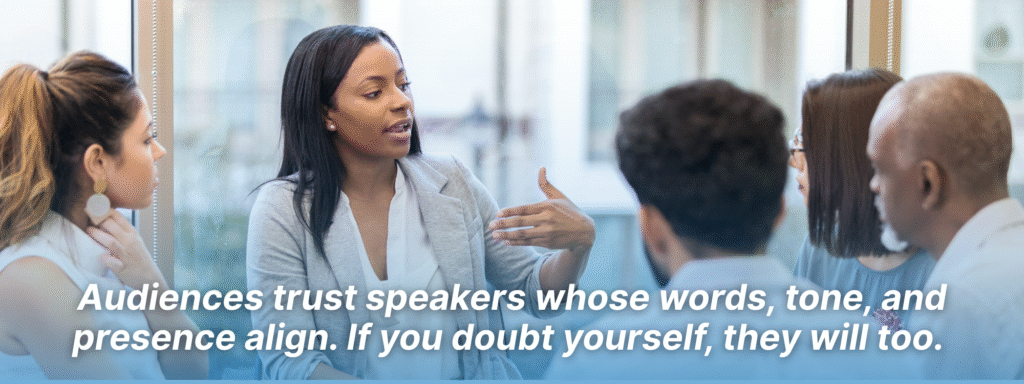
Audiences trust speakers whose words, tone, and presence align. If you doubt yourself, they will too. But if you stand firm in your message, they will lean in. If your voice trembles with uncertainty, if your body language is guarded and hesitant, they will feel it, even before they register it consciously. But if your words and actions are in harmony, if your gestures match your message, if your voice carries conviction, they will lean in. They will listen.
Forget performance. A great speech is not a recital—it’s a conversation, alive in the moment, as if spoken just for them. No matter how large the audience, you are still speaking to people, not a faceless mass. A well-delivered speech feels personal. It feels like it belongs to them. This is why the greatest orators—Winston Churchill, Martin Luther King Jr., Malala Yousafzai—never sound as though they are reciting something memorised. They sound as if they are speaking directly to you, in this moment, as if the words have just been born.
That is the secret. Not perfection, not flawless articulation, but authenticity. The audience does not need you to be a grand orator. They need you to be present—to speak with them, not at them.
Stage Stories: Becoming Engaging
Facts inform, but stories transform. Logic may win debates. But stories win minds, move hearts, and stay imprinted in memory long after facts are forgotten. The most powerful speeches in history—those that changed minds, galvanised movements, altered the course of history—were not composed of dry statistics and abstract principles. They were carried by stories.
Why? Because stories bypass resistance. If you tell someone they are wrong, they will raise their defences. If you shower them with data, they may nod politely but feel nothing. But tell them a story—about a struggle, a triumph, a moment of revelation—and suddenly, they are inside the idea. They are experiencing it, rather than analysing it.
The best speakers understand this. They do not merely present information; they weave it into a narrative. They weave conflict, tension, and resolution into something unforgettable. They paint images so vivid that the audience can see them, feel them. A great speech is not a list of points. It is a journey, one that the listener embarks upon willingly.
Consider one of the most famous speeches in history: Martin Luther King Jr.’s ‘I Have a Dream’. He could have delivered a policy paper. He could have listed statistics about racial inequality. Instead, he painted a world—a world where his children would not be judged by the colour of their skin, but by the content of their character. He did not just argue for justice; he made people see it, feel it, yearn for it.
This is the kind of storytelling that stays with an audience long after the speech is over. Not because the words were memorised, but because they were felt.
And it is not reserved for historical giants. Even in a business meeting, a conference talk, or a wedding toast, the same principle applies: a story is what makes people care. If you can make them care, you can make them remember.
Stage Presence: Giving Thoughts That Linger
The best speeches are not those that impress in the moment but those that echo long after the last word has been spoken. And this does not come from flashy rhetoric or dramatic gestures; it comes from a deeper place.
It comes from presence.
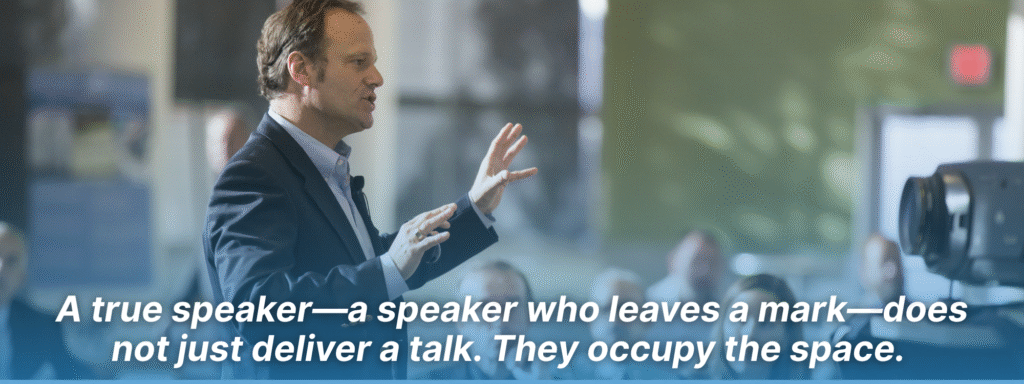
A true speaker—a speaker who leaves a mark—does not just deliver a talk. They occupy the space. They hold it, command it, shape it. This does not mean theatricality. It means being fully there, with nothing held back.
The final and most powerful tool is not technique. It is not breathing exercises, or structured arguments, or even the art of storytelling. It is the decision to own the moment.
When you walk onto a stage, you are not merely delivering a message. You are creating an experience. And the ones who do it best are those who step forward fully, without hesitation, without apology.
True presence is not a trick; it is not an exaggerated performance of confidence. It is the undeniable weight of someone who believes in what they are saying. It is the difference between a speaker who simply occupies the stage and one who owns it. Presence is a force, a kind of gravity that pulls the audience in. And that gravity is built from conviction, from clarity, from the unwavering decision to be here, now, fully engaged.
The greatest speakers do not leave their audiences with mere words; they leave them with feeling, with vision, with momentum. When they step off the stage, their presence lingers, rippling through the minds of those who have just listened. This is because they understand a fundamental truth about public speaking: it is not about performance. It is about transfer. A transfer of belief, of energy, of certainty.
When you step onto a stage—physical or virtual—you are stepping into an opportunity. A chance to ignite something that did not exist before—a new idea, a fresh perspective, a shift in understanding. And that fear? It was never the enemy. It was proof that this moment matters. And if it matters—step into it, fully. Step into it and own it. Without the stakes, without the charge of adrenaline, it would just be another mundane exchange of information. But a speech is not mundane. It is alive. It is your chance to take something abstract and breathe it into reality.
And so, the final challenge: Step forward—not to endure, not to survive, but to own the stage. Speak not as if this moment belongs to you—but as if you belong to this moment. Take the stage. Speak with conviction. Stand in the fullness of your voice, your ideas, your presence.
Because in the end, no one remembers a speaker who was merely competent. They remember the one who moved them—who made them feel, who made them believe, and who left them changed.