
Regulating Yourself Before Leading Others
The first thing people notice about a leader is never the strategy. Nor the credentials, nor the presentation waiting patiently on slide one. What they notice is whether you steady the room or stir it. Whether your presence calms the air or agitates it. Before a single word is spoken, you have already announced yourself.
Some do this accidentally; some never learn how. The rest discover, often painfully, that leadership begins in the body long before it is expressed in action. This is the silent discipline is unadvertised, unfashionable, occasionally inconvenient It is regulating yourself before you begin to give directions to anyone else.
It sounds obvious. It is not. Most leaders are convinced that control is something exerted outward: on decisions, on teams, on problems queuing up like unpaid bills. Meanwhile, their own nervous system is behaving like an untrained intern, sending the wrong memos at exactly the wrong moment. A tightened jaw here, a clipped breath there, eyes scanning for threat instead of possibility. And people notice. They always notice.

Because leadership is not performed first in language; it is performed in physiology. You broadcast state before you broadcast intent. If your body is still fighting yesterday’s battle, today’s team will feel it before you do.
This is why the best leaders do not begin with charisma, vision, or even competence. They begin with recovery. They begin by closing the tabs in their mind, levelling their breathing, anchoring their attention in the present instead of the catastrophe their imagination is auditioning. They recover before they react, so they do not bleed yesterday’s stress into today’s conversation.
It is not glamorous work. No-one updates LinkedIn to announce they’ve mastered the art of not panicking. No keynote has ever sold out because the pamphlet promised: Come learn how to keep your shoulders down when everything goes sideways. But this is the work that separates accidental leadership from deliberate leadership.
Self-Regulation Shapes Better Decisions
Those who rely on talent, charm, or force tend to lead cleanly only when the environment co-operates. The moment uncertainty enters the room—an awkward question, a shifting deadline, a silence that stretches a second too long—the façade cracks. Behaviour spills. Tone sharpens. Their influence contracts. People begin to armour up around them.
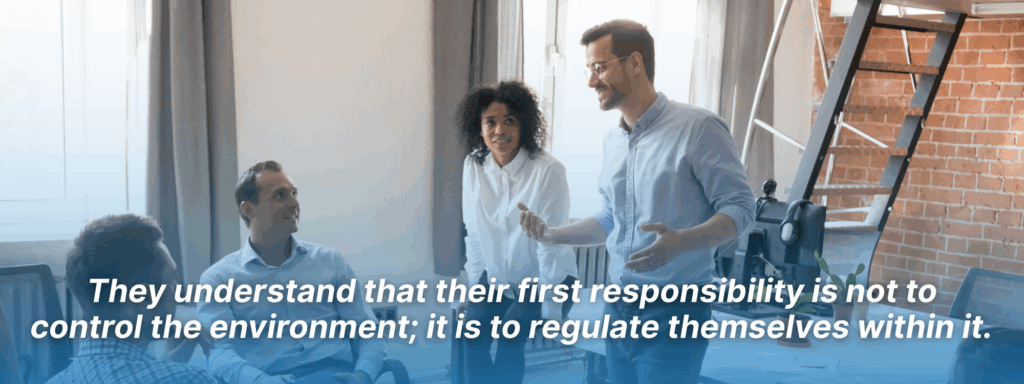
But the leaders who practise the silent discipline operate differently. They understand that their first responsibility is not to control the environment; it is to regulate themselves within it. They don’t rush to fill silence. They breathe. They let the nervous system settle before the mind intervenes. They buy themselves those precious three seconds where clarity arrives before habit. And in those three seconds, they often prevent an entire sequence of avoidable mistakes.
Self-regulation is not a moral virtue; it’s a strategic one. It allows leaders to think at the level their role requires, rather than the level their stress threatens to drag them down to. It preserves cognitive bandwidth. It protects relationships. It reduces the self-inflicted friction that derails otherwise competent people. It also makes leadership look effortless; whilst it is anything but.
Self-Regulation Builds Stability and Influence
But the real value of self-regulation is what it makes possible: your capacity to become a stable reference point for others. Teams do not need perfect leaders; they need predictable ones. They need someone who can walk into a storm without adding weather of their own. Someone who can absorb emotion without amplifying it. Someone who can choose response over reflex.
When people follow a leader who steadies themselves first, they unconsciously grant that leader more social permission: permission to direct, to challenge, to stretch them, to hold them accountable. Influence thickens in the presence of stability. Authority travels further when carried by a grounded body.
And the inverse is equally true. Leaders who have not learned to regulate themselves generate unseen emotional taxes. Their team becomes translators of their moods, anticipating which version will arrive today. Meetings become emotionally expensive. People hesitate before bringing bad news until the organisation stops bringing it altogether.
The silent discipline prevents this. It recovers clarity before decisions. It reopens curiosity when stress tightens the margins. It transforms the body from a source of noise into an instrument of signal.
This does not mean suppressing emotion or performing serenity like a budget monk. It means building the capacity to return to yourself quickly, consistently, and without theatrics. It means recognising when your system is shifting from steadiness to defence and adjusting course before the shift becomes behaviour. Some do this through breath; some through posture; some through metaphor; some through a sentence they say to themselves that brings them back to centre. The method is personal. The discipline is universal.
In the end, the quietest work becomes the loudest. You arrive differently. You listen differently. You speak less to be right and more to be useful. And people feel safe enough around you to tell the truth; which is, incidentally, when leadership finally becomes worth the trouble.
You cannot lead others beyond the state you yourself can access. You cannot ask for steadiness you have not practised. You cannot demand alignment when you are signalling disarray. Your body sets the terms long before your words attempt to.
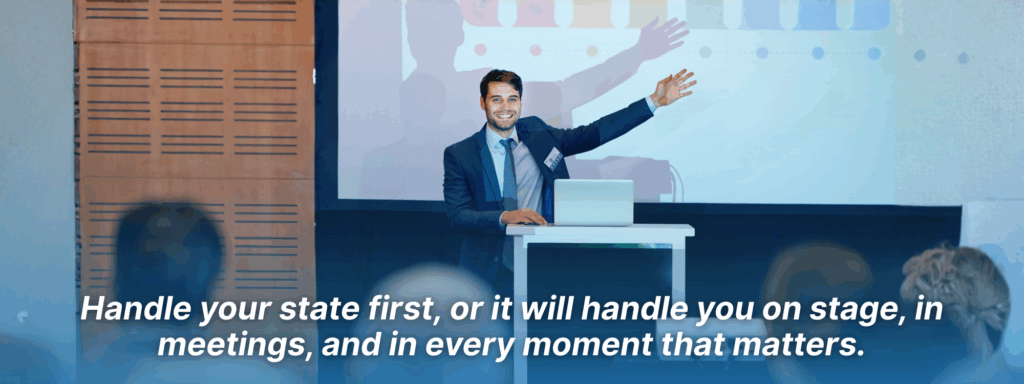
So, the silent discipline is not optional; it is foundational. Handle your state first, or it will handle you on stage, in meetings, and in every moment that matters.
Leadership begins in the body. Everything else is commentary.