
Most leaders are trained to listen for what is spoken. They take notes, track key points, mentally organise arguments, and respond to the content presented. This habit creates a flattering illusion of being attentive. In practice, what shapes a team’s behaviour has very little to do with what is said aloud. It lives instead in the silences, the hesitations, the detours, and the subtle ways people adjust themselves when the conversation moves into uncomfortable territory.
If you rely only on spoken words, you will consistently misread people. Not because the words are dishonest, although they often are, but because the spoken layer of communication is the most edited layer. People sanitise it. They trim it. They disguise their motives with the sort of diplomatic packaging that keeps meetings civil but deeply uninformative.
The truth of the situation lives below the surface. It is rarely uttered. It is almost always visible.

The Subtly of Omission
Omission is a form of communication as real as any sentence. When a person avoids a topic, they are speaking. When they answer quickly and thinly, they are speaking. When they provide detail in the wrong places, or too much in one place and too little in another, they are speaking. The leader who listens only to the verbal layer will interpret such evasions as compliance. The leader who listens to absence will hear the real message: I do not trust this situation enough to be fully seen.
Silence does not mean agreement. It rarely means comfort. It is usually the sound of someone calculating risk. People remain silent when they fear judgement. They remain silent when they believe the leader’s state cannot accommodate the truth. They remain silent when the emotional cost of honesty feels too high.
This is why reading the unsaid is essential. The unsaid is where the organisation hides everything it does not know how to express directly.
The Body Tells the Story First
If you pay attention, the body will tell you the truth before the mouth has a chance to edit it. When a person becomes cautious, their breathing shifts. When they feel exposed, their shoulders lift. When they are internally resisting a request, their eyes flicker away at the exact moment they say yes. These are not mystical signals. They are physiological reactions to meaning.
Teams reveal their internal weather through posture. The person who sits forward is not necessarily engaged. They might be anticipating disagreement. The person who leans back is not necessarily relaxed. They might be retreating. The person who crosses their arms might not be defensive. They might simply be cold, although if they remain crossed as the stress in the conversation rises, you now have context.
None of these signals should be interpreted in isolation. They form a pattern. And patterns speak.

State as Interpreter
Reading what is not said requires a particular type of internal stillness. If the leader enters the room with unresolved tension, the tension becomes a distorting lens. Everything is interpreted through the residue of the previous moment. A neutral comment sounds like challenge. A simple question feels like critique. A hesitation is assumed to be incompetence rather than caution.
A leader who reads the unsaid accurately has learned to neutralise their internal weather before interpreting someone else’s. This is not emotional suppression. It is emotional preparation. It prevents projection from masquerading as insight. It allows the leader to study subtle cues without inserting meaning that is not there.
Leadership becomes dangerous when the leader mistakes their own internal commentary for objective observation. Reading the unsaid requires humility, because you are interpreting the emotional data of another human being, not confirming your own narrative.
The Courage of a Hesitation
Most people do not hesitate because they are incompetent. They hesitate because they are weighing the personal cost of speaking openly. A pause often indicates that the person is searching for a safe version of a truth. A detour into irrelevant detail can indicate that the real issue feels too charged. A sudden change in tone can signal that the person has moved from the realm of facts into the realm of vulnerability.
If the leader responds to hesitation with impatience, the truth disappears. If the leader responds to hesitation with curiosity, the truth approaches. The difference is simple. Curiosity is a low threat signal. Impatience is a high threat one. People will risk honesty with someone who is curious. They will not risk it with someone who is irritated.
The unsaid is not a barrier to information. It is a request for safety.
Why Teams Speak in Code
Teams develop coded ways of speaking because it feels safer than voicing the truth directly. They say, We are not fully aligned, when they mean, We are in conflict and no one wants to deal with it. They say, We might need more clarity, when they mean, The current plan does not make sense. They say, I have a few concerns, when they mean, This will fail unless something significant changes.
If the leader takes the coded language at face value, the problems remain encrypted. If the leader reads the code beneath the words, the real issues become visible. This is the point at which genuine progress becomes possible.
Language, in organisational life, is often an attempt to avoid emotional consequence. Reading the unsaid frees people from the burden of hiding behind euphemisms.
Leadership Growth
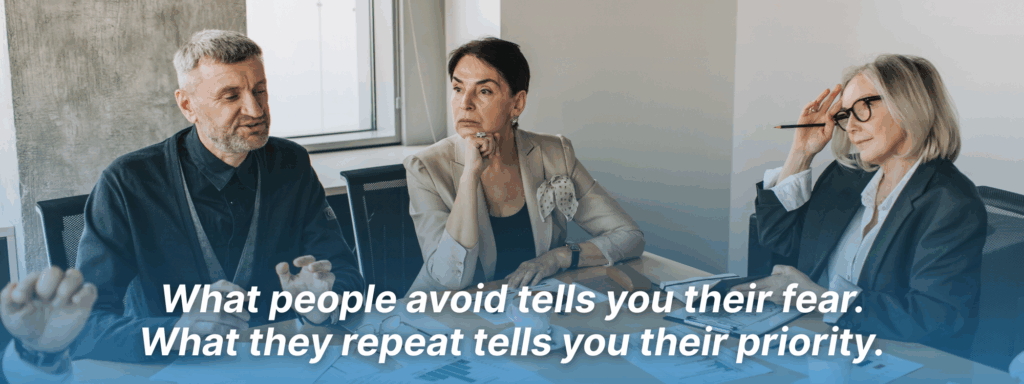
Eventually leaders learn that the spoken layer is merely the performance of communication. The real information lives beneath it. What people avoid tells you their fear. What they repeat tells you their priority. What they soften tells you where they feel exposed. What they do not say tells you the cost they are trying to manage.
Reading the unsaid is not manipulation. It is the practice of paying attention in a way that grants others the dignity of being understood. It turns conversations from transactions into insight. It allows the leader to respond to meaning rather than merely reacting to language.
The organisation you lead is not the one described in reports or meetings. It is the one revealed in the small signals people hope you will notice without being asked.