
There is a moment in every seasoned leader’s career when the room feels slightly unfamiliar. You are still in it. You still hold the title. But someone else is speaking from the head of the table. They frame the issue differently. They choose a different order. They emphasise points you would have weighted more lightly and skim past details you once guarded like crown jewels.
You feel it in the chest. Not anger. Not quite pride either. Something warmer and sharper.
The torch is being passed. And it is hot.
If you have built something from scratch, or carried it through storms, or steadied it when others wobbled, that torch is not an object. It is biography. It holds your late nights, your near misses, your internal calculations that never made it into minutes. Letting someone else carry it can feel less like delegation and more like erasure.
That is why succession so often falters.
It is rarely the absence of strategy that derails it. Plans can be written. Structures redesigned. Role descriptions clarified. Interim leaders installed. Consultants hired with tidy slide decks and reassuring timelines. All the external architecture can be immaculate.
The internal architecture is harder.
If your identity is fused with your competence, stepping back feels like diminishment. If your worth has been measured by indispensability, becoming unnecessary feels like loss. You tell yourself you are protecting the organisation. Sometimes you are. Often you are protecting yourself.
Most leaders think they are handing over tasks. What they are actually holding onto are maps.

What You’re Really Passing On
Skills are easy to transfer. You can teach someone how to run a meeting, read a balance sheet, respond to a complaint, manage a risk register. These are visible. They have agendas, templates and metrics.
However, maps are different.
Maps are how you see.
You know who really influences whom, even if the organisational chart pretends otherwise. You know which silence in a meeting signals confusion and which signals dissent. You know which data point is noise and which is the beginning of a trend. You know where the informal power sits, where the loyalties lie, and which trade-offs hide beneath apparently simple decisions.
You did not learn these from a manual. You learned them through exposure, missteps and a thousand micro-adjustments. They are embedded in your perception.
If you pass on only skills and keep your maps private, the next leader must rediscover the terrain by walking into walls. That is how torches burn. Not through malice. Through omission.
Passing the torch without getting burned requires making the invisible visible.
Instead of saying, ‘Here is what to do,’ you begin to say, ‘Here is what I noticed.’ Instead of offering only conclusions, you narrate your reasoning. ‘I discounted that option because…’ ‘I hesitated here because…’ ‘This is what worried me, even though it did not make the report.’
You expose your thinking.
This can feel uncomfortable. It reveals uncertainty. It dismantles the illusion of effortless authority. But it accelerates maturity in a way no checklist ever will. You are not handing over answers. You are handing over lenses.

The Torch Trap: Rescue or Retreat
The temptation, of course, is to rescue.
You watch them chair a meeting and wince at a phrase you would not have used. You see them delay a decision you would have made quickly. You feel the urge to step in, to correct publicly, to rewrite privately, to hover until the outcome aligns with your preference.
While rescuing soothes your anxiety, it also suffocates growth.
The opposite temptation is abdication. You announce the transition, withdraw abruptly and tell yourself they will learn the hard way. You remove scaffolding before the building can stand. When they stumble, you shake your head in quiet vindication.
Both responses are ego moves.
One says, ‘Only I can do this properly.’ The other says, ‘I am done here.’ Neither develops leaders.
The work sits in the middle.
You remain available but not intrusive. You allow decisions to unfold, even if they unfold differently. You intervene when integrity or safety is at risk, not when preference is offended. You correct privately and specifically, not theatrically. You debrief after events rather than rewriting them midstream.
And you accept a difficult truth: they will not lead like you.
They should not.
They will prioritise differently. They will speak with a different cadence. They will build alliances in ways you would not have chosen. If outcomes are sound and values intact, difference is not error. It is evolution.
This requires a particular form of discipline. You must separate continuity from control. Continuity protects purpose. Control protects ego.
Not every aspiring leader is ready for deep reflection. Some lack experience. Some lack trust. Some struggle to articulate their thinking. Development is contextual. If the foundations are thin, you begin with behavioural clarity. ‘This is the standard. This is the outcome. This is the observable shift required.’ Structure first.
When the Torch Moves Forward
When trust and articulation are present, you can go deeper. You can ask, ‘What were you seeing in that moment?’ ‘What trade-off did you prioritise?’ ‘What did you ignore?’ These questions build maps. They shift leadership from imitation to insight.
Over time, something subtle happens. The system stops depending on your constant presence. Decisions do not stall in your absence. Conversations continue without waiting for your nod. The torch moves, not because it was forced from your hand, but because others can now hold it without burning themselves.
This is legacy reframed.
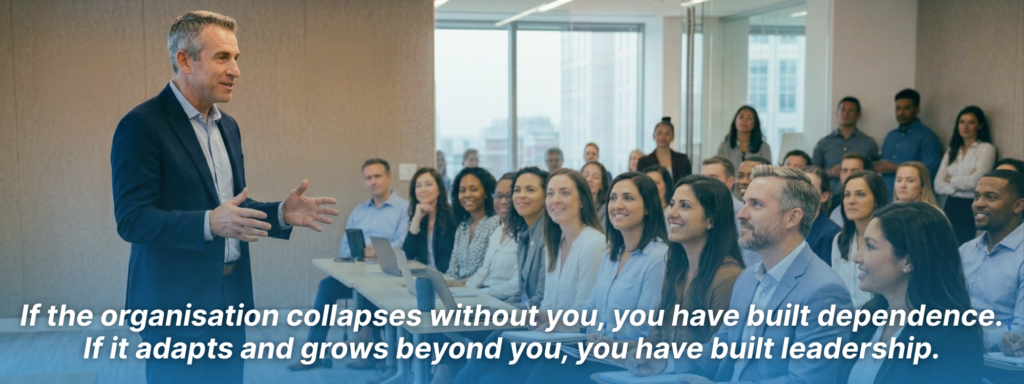
Legacy is not being remembered in every corridor. It is being unnecessary in the daily mechanics. If the organisation collapses without you, you have built dependence. If it adapts and grows beyond you, you have built leadership.
The founder who cannot release control becomes a bottleneck, even if they began as a visionary. The seasoned manager who withholds their maps preserves status but slows succession. The leader who shares how they see, how they weigh, how they doubt and decide, multiplies capacity.
Passing the torch is not about stepping aside theatrically. It is about stewarding a transfer of perception.
You will still feel that tightening in the chest from time to time. That is normal. The torch was warm in your hand for years. Letting someone else carry it is not trivial. It marks the end of a chapter in which you were central. But if you have done the work properly, the flame does not flicker. It spreads.And when you see it carried forward, shaped by different hands yet steady in its light, you realise something quietly profound.
The fire was never yours to own. It was yours to tend.
Passing it on without getting burned is not about cooling the flame. It is about trusting that it no longer needs your grip to survive.