
It started, as these things often do, with the confidence of someone convinced they were right. I had the data, the experience, the job title. The other guy had… well, conviction. The sort that made people lean in when he spoke.
The meeting began politely enough. Coffee cups. Small talk. The gentle clearing of throats that signals something weightier on the way. I laid out my case with the precision of a man who has practised his lines in the shower. Projections, timelines, risk factors — all lined up like obedient soldiers.
And then he dismantled it. Calmly. Point by point. Like watching someone casually pull threads from a jumper until you realise you’re standing there in the cold with nothing on.
The room shifted. People who had nodded along with me now made those little ‘he’s got a point’ faces. By the end, my carefully constructed argument lay in pieces, and everyone knew it.
I had lost. Publicly. Unequivocally.
The Aftermath
I’d like to say I handled it with grace. That I smiled, conceded the point, thanked him for the insight.
In reality, I managed something between a grimace and a nod, the universal expression for ‘let’s move on before I invent a time machine to undo this’.
The worst part wasn’t losing the argument. It was realising how badly I needed to win it. That stung. Because needing to win is a terrible look on a leader. It reeks of ego dressed up as authority.
But that moment — humiliating, clarifying — did something important. It held up a mirror I couldn’t ignore.
The Leadership Myth
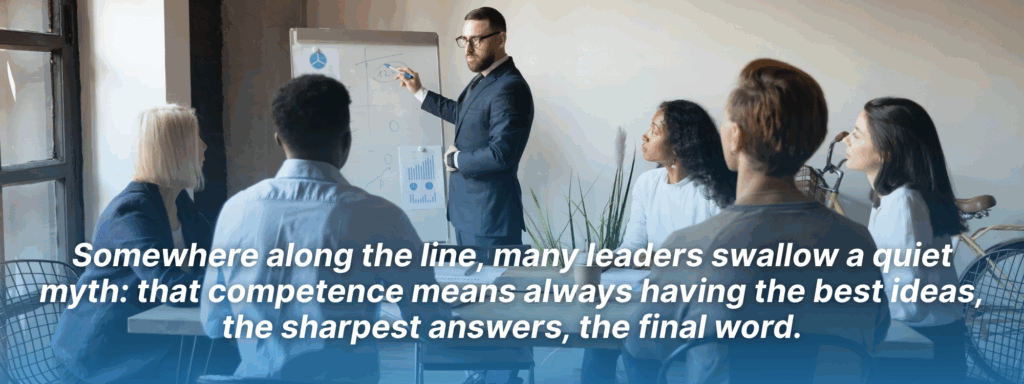
Somewhere along the line, many leaders swallow a quiet myth: that competence means always having the best ideas, the sharpest answers, the final word. That confidence depends on certainty, and authority depends on being right.
It’s nonsense, of course. But seductive nonsense. It makes leadership look like a performance: never hesitate, never wobble, never lose.
The problem is obvious once you say it out loud. Teams stop telling you the truth. They protect your ego instead of the work. Meetings become theatre: everyone playing their part while the real conversations happen in corridors and WhatsApp groups afterwards.
That day in the meeting, losing the argument cracked the myth wide open. Because what people remembered afterwards wasn’t my failed case. It was how the better idea won. How the team left clearer, more aligned, more energised — precisely because the strongest argument carried the day rather than the highest-ranking voice.
The Temptation to Defend
Of course, the instinct to defend yourself in the moment is strong. You feel the room tilt, feel authority slipping through your fingers, and the urge is to grab it back by talking louder, faster, longer.
But defending a weak position just because it’s yours is how leaders end up looking ridiculous. Everyone sees the cracks widening while you insist the structure is sound. It’s like arguing with the weather: the storm doesn’t care, and you get soaked anyway.
The hardest discipline in leadership is shutting up when you want to win the most. Listening even as your ego howls for reinforcements. Letting the better idea through, even when it’s not yours, especially when it’s not yours.
What Losing Taught Me
First, humility isn’t a leadership accessory. It’s infrastructure. Losing forced me to confront the difference between authority and arrogance. One builds trust; the other strangles it.
Second, teams watch everything. How you handle defeat teaches them more about psychological safety than any amount of cheerful posters about ‘open culture’. When leaders lose well — acknowledge it, adapt, move forward — teams learn it’s safe to speak up, to challenge, to experiment without fearing the guillotine.
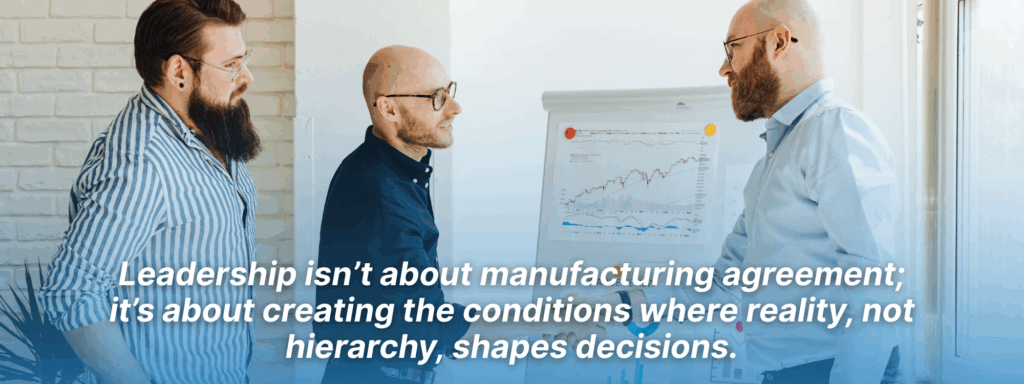
Third, the work gets better. That meeting produced a stronger plan than the one I walked in with. Not because I lost, but because the best idea won. Leadership isn’t about manufacturing agreement; it’s about creating the conditions where reality, not hierarchy, shapes decisions.
The Ego Problem
Ego hates all this, of course. It prefers control, predictability, applause. It wants to be the smartest voice in the room, the hero in every story.
But leadership built on ego becomes brittle. People stop bringing bad news. Risks stay hidden until they explode. Innovation flatlines because no one wants to outshine the boss.
Losing that argument exposed how easily ego can masquerade as confidence. Real confidence, I realised, doesn’t need to win every point. It can absorb challenge without falling apart. It can change its mind without feeling humiliated.
The Longer View
Months later, people barely remembered the details of that meeting. What they remembered was that we argued, decided, and delivered something that worked.
No one cared that my original plan didn’t survive contact with scrutiny. They cared that the team left aligned, that the project landed, that the culture afterwards felt looser, sharper, more alive.
Losing publicly had punctured whatever distance existed between leader and team. I stopped performing certainty and started inviting challenge. Meetings grew louder, faster, funnier. Ideas collided more honestly. And strangely, my authority didn’t shrink. It grew. Because people trusted it more.

The Paradox of Losing
Here’s the paradox: leaders who can’t lose arguments eventually lose everything else. Trust. Candour. The flow of unfiltered information that keeps decisions tethered to reality.
The win-at-all-costs leader might feel powerful for a while. But they end up surrounded by cautious, silent teams who wait for instructions instead of thinking for themselves.
Losing, it turns out, keeps you honest. It reminds everyone the goal is getting it right, not being right.
The Leader After Losing
I left that meeting with a bruised ego and a better team. I learned to ask more questions, to invite dissent early, to treat ideas like prototypes rather than personal property.
And the next time I lost an argument — because there’s always a next time — I recognised it for what it was: proof the culture was working.
Because leadership isn’t measured by how often you win. It’s measured by whether the best ideas survive, even when yours don’t.