
Leadership often begins with the assumption that authority is a matter of outlining, directing, instructing, and correcting. Early in a leader’s career this feels appropriate. Problems appear linear, tasks appear solvable through pressure, and people appear manageable if approached with the right level of firmness. The command reflex is seductive because it works in simple situations. It provides clarity. It offers control. It satisfies the ego.
But as responsibilities grow, the limits become obvious. Teams resist being steered like machinery. Stakeholders push back against directives that do not take their concerns into account. Problems become less mechanical and more human. Complexity reveals that command is often the fastest path to misunderstanding. And at some point, a leader who relies on command feels an unmistakable sensation: they are working harder while achieving less.
This is the moment when curiosity begins to matter. Not as a personality trait, but as a leadership tool.
Shift in Posture, Not Politeness
Curiosity is often misunderstood as a kind of wide-eyed enthusiasm, a cheerful willingness to explore ideas. In leadership it is something far more deliberate. Curiosity is a physiological shift from tightening to opening. It changes how you look at people, how you interpret behaviour, and how you respond to tension. It replaces the instinct to control with the intent to understand.
Command assumes the leader already knows. Curiosity assumes the leader does not yet know enough. Command reduces complexity to fit the leader’s pre-existing frame. Curiosity allows the frame to adjust to reality. Command creates defensiveness. Curiosity disarms it.
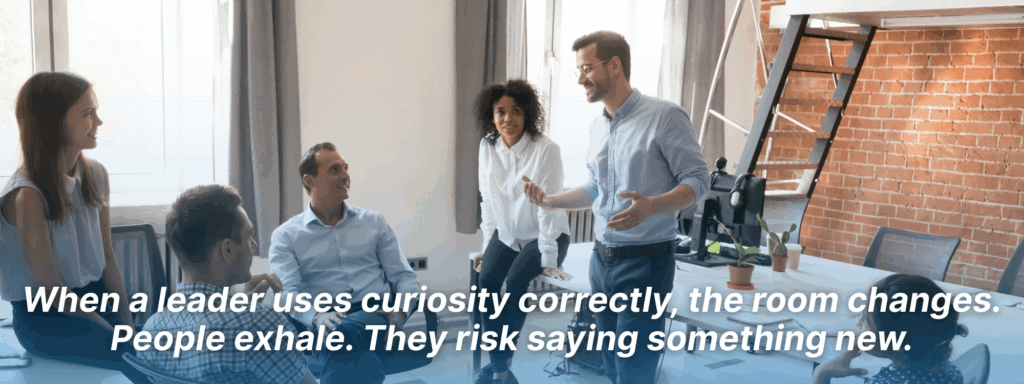
When a leader uses curiosity correctly, the room changes. People exhale. They risk saying something new. They stop performing the version of themselves that is least likely to be criticised and start sharing the thinking that might actually matter.
When Curiosity Meets Conflict
Conflict is the arena in which the shift from command to curiosity is most visible. A leader driven by command meets conflict with pressure. They narrow their tone. They sharpen their questions. They attempt to correct the other person’s position. This escalates tension, because the body of the other person interprets the leader’s approach as threat. Once threat is perceived, collaboration collapses.
A curious leader approaches the same conflict differently. They widen their perceptual field. They slow their response. They ask questions aimed not at winning but at understanding. What are you protecting here. What do you need that you do not yet trust you will receive. What part of this feels risky. These questions are not therapeutic. They are strategic. They reveal the emotional architecture beneath the disagreement.
Conflict softens when the underlying fear or hope is named. People become less rigid. Solutions emerge that were previously hidden behind defensiveness. Curiosity does not eliminate conflict. It makes conflict productive.

A Corrective to Projection
One of the quiet dangers of leadership is projection. Leaders often assume they know why someone hesitated, resisted, or disagreed. They interpret behaviour through the lens of their own fears, biases, and irritation. This creates distortion. And distorted interpretation leads to distorted decisions.
Curiosity interrupts this pattern. It forces the leader to slow down and seek accuracy before judgement. It prevents the leader’s internal weather from becoming the team’s reality. It replaces assumption with inquiry and reintroduces nuance where certainty has become premature.
The curious leader becomes harder to provoke because their attention is not consumed by defending their own identity. They are not threatened by dissent because dissent becomes data. They do not mistake emotion for disrespect. They do not confuse hesitation with incompetence. They interpret behaviour rather than reacting to it.
Curiosity protects leaders from their own imagination.
Curiosity’s Somatic Foundation
Curiosity does not begin in the mind. It begins in the body. A curious leader breathes differently. Their jaw softens. Their eyes steady rather than narrow. Their posture creates invitation rather than closure. These signals matter. When a leader’s body communicates openness, people reveal more. When the leader’s body communicates pressure, people conceal.
This somatic shift is not cosmetic. It changes the information available. Without curiosity, people share only what feels safe. With curiosity, they share what is true.
The leader who thinks curiosity is simply a mental exercise will not understand why their questions do not land. The body has spoken long before the question arrives, and the room has already decided whether honesty is wise.

From Authority to Partnership
Command positions the leader above the team. Curiosity positions the leader alongside the team. This does not diminish authority. It strengthens it. People respect leaders who attempt to understand them. They follow leaders who show genuine interest in their thinking. They trust leaders who acknowledge the limits of their own perspective.
Curiosity creates partnership without diluting accountability. It says, Tell me what you see, then let us decide what must be done. It balances humility with responsibility. It allows the leader to remain authoritative without becoming authoritarian.
Over time, curiosity builds an environment in which people think more boldly, speak more honestly, and work with greater intelligence. Command creates compliance. Curiosity creates contribution.
Key Realisation
In the end, leaders discover that curiosity is not a soft accessory, but a strategic competence. It keeps the leader accurate. It keeps the room open. It prevents unnecessary conflict. It reveals hidden risks. It surfaces unspoken truths. It protects against projection. It steadies the nervous system. It expands the possible. It allows solutions to emerge that command would never have uncovered.
Curiosity does not replace authority. It refines it. It gives authority depth. It makes authority humane. It turns leadership from a performance into a form of conversation.
Command may work in simple situations. But in complexity, curiosity is what keeps a leader capable.