
Bonds That Last
There are few things in life more mysterious than true friendship. It does not demand fidelity as family does, nor does it carry the heady intoxication of romance. It is not bound by blood, vows, or legal contracts—yet, paradoxically, it can often outlast them all. It is chosen, not assigned. It survives without obligation. It persists through distances that dissolve marriages and through silences that would doom professional alliances. It exists in a world obsessed with labels, yet it refuses to be categorised.
And still, despite its undeniable presence in the human experience, true friendship remains an enigma. Why do we invest so much in those with whom we share neither genetics nor passion? What compels us to maintain bonds that serve no obvious function in a society that measures worth in transactions? And why, when these friendships are lost, does the grief cut as deeply as any broken love?
To understand friendship is to understand something fundamental about what it means to be human. This is not an essay about casual friendships—the colleagues, the friendly acquaintances, the people whose presence is contingent on convenience. This is about the rare ones, the ones that shape lives. The friendships that endure across decades, through hardships, across divides of gender, orientation, and age. These are the friendships that do not just add meaning to life but define it.

The Paradox of Choice
Unlike family, which is given, and romance, which is often driven by need, deep friendships are acts of pure volition. And therein lies their paradox—they are fragile in their lack of structure, yet unbreakable in their depth.
A true friend carries no duty to stay, no contract binding them to return, no expectation they must fulfil. They remain because they choose to, and that choice, made day after day, year after year, is what gives friendship its quiet power. This is why deep friendships can withstand disappointments that would shatter marriages and endure separations that would erode familial ties. It is why a friendship rekindled after years apart can feel as though no time has passed at all.
There is an unspoken promise embedded in every deep friendship: I will bear witness to your life. Not as a spectator, but as someone who really sees you—not the curated self you present to the world, but the raw, unguarded self beneath.
In a world where every relationship is measured by what it produces—romance by its passion, family by its duty, work by its output—friendship exists outside the system. It cannot be monetised, optimised, or scheduled into a five-year plan. It exists in stolen hours, in late-night conversations that serve no purpose other than connection, in the silent understanding that some bonds require no justification.
It is, in every sense, an act of defiance.

Friends Will Be Friends
Masculinity has long been defined by restraint. From the battlefield to the sports pitch, men have forged bonds in shared action rather than spoken sentiment. A slap on the back instead of an embrace. A nod instead of a confession. But beneath the surface lies something deeper—a connection that reflects risk, laughter, protection and trust. The one who defends you when you are not there to defend yourself. The one who sits beside you in silence when there are no words that can fix what has broken.
While men’s friendships are often defined by quiet solidarity, women’s friendships thrive on expression. From adolescence onwards, they are built on shared secrets, emotional validation, and an unspoken promise to bear each other’s histories. To have a close female friend is to have a witness to one’s life. Someone who remembers the details no one else does. Someone who holds your past when you no longer can. These friendships can be unbreakable lifelines—deep, emotional constellations that light the path through life’s darkest moments.
For centuries, society treated the idea of deep, platonic friendship between men and women as an impossibility. Yet reality tells a different story. True opposite-sex friendships offer something rare—a connection unburdened by the expectations of romance or the competition of same-gender social circles. They exist outside traditional scripts, offering a different kind of emotional sanctuary.
In a world that increasingly silos generations into separate spaces, intergenerational friendships bridge a divide that few cross. For younger people, they offer a broader lens, a reassurance that most troubles, no matter how overwhelming, eventually pass. For the older friend, there is a kind of renewal—a fresh way of seeing the world, a reminder that life is still unfolding. These friendships are not lessons disguised as companionship; they are reciprocal, dissolving the boundaries of time.
Friendships between individuals of different sexual orientations hold a unique space in human connection. In a world still grappling with prejudice, these bonds are built on trust, on the willingness to step outside assumptions. At their best, they are a quiet rebellion against the divisions the world would impose—proof that connection is built on something deeper than identity alone.
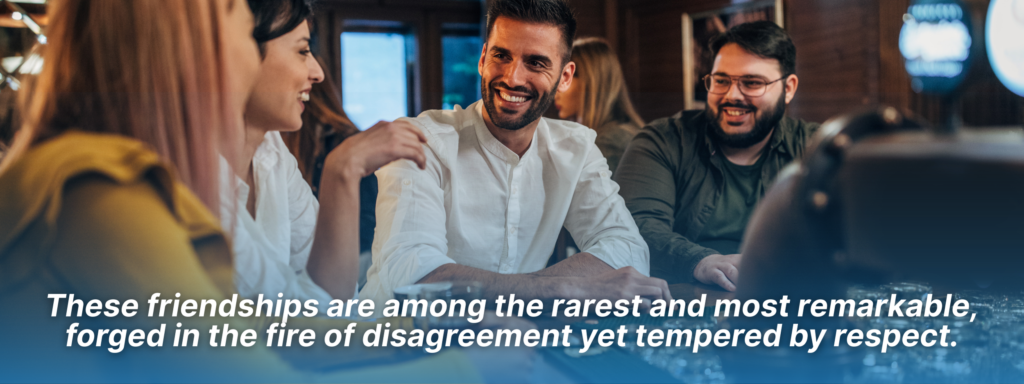
Some friendships endure not just across personal differences, but across ideological and religious divides. These friendships are among the rarest and most remarkable, forged in the fire of disagreement yet tempered by respect. In an era where beliefs have become battle lines, where conviction often hardens into separation, there are still those who choose to reach across the chasm. They do not ignore their differences, nor do they attempt to convert or erase them. Instead, they stand as living proof that friendship is not about perfect alignment, but about the willingness to listen, to challenge, and to remain in each other’s lives—not despite their differences, but because of them.
Friendship, in its truest form, enjoys companionship for its own sake.
Final Thought
Unlike family, which is given, or romance, which is often tethered to expectation, friendship is an ongoing act of recognition. A true friend is someone who sees you—not just as you present yourself, but as you have always been. Someone who, in a world of shifting tides, remains constant and grounding.
Perhaps, in the end, the truest essence of friendship is not found in grand gestures or endless conversations, but in the quiet certainty that, despite everything, there is someone who really knows you, who really sees who you are—and stays.