‘To live this way is to choose depth over speed, presence over performance…
That is the heartbeat of amouria, whether named or not’
It began with the lights in the supermarket. Cold. Overhead. Flickering just enough to unsettle the corner of your vision. You hadn’t slept well. The queue was long. Something small—a barcode error, maybe—brought everything to a halt. Someone sighed. A child whined. You felt your jaw tighten. You were suddenly aware of your heart thudding—not fast, just loud. And a thought passed through you, quiet but undeniable:
I can’t do this today.
You didn’t cry. You didn’t shout. You stood still. But something inside you folded, not in defeat, but in disbelief that this was your life now—measured out in receipts, empty glances, and the hum of fluorescent lights.
That’s the moment. The one you don’t write about on social media. The one too mundane to name but too heavy to forget. It’s not trauma. It’s not drama. It’s erosion. And erosion doesn’t announce itself—it just wears you down, grain by grain, until the shape of your spirit starts to change.
And maybe you got through it. You paid. You nodded. You carried the bags back to your car and you made dinner and answered messages and said ‘I’m fine’ and you were. Sort of. But somewhere in the hours that followed, you asked yourself—is this it? Not in despair, but in a quiet, aching hope that maybe… just maybe… there’s still something in the world that can reach you, even here. And that’s where amouria begins. 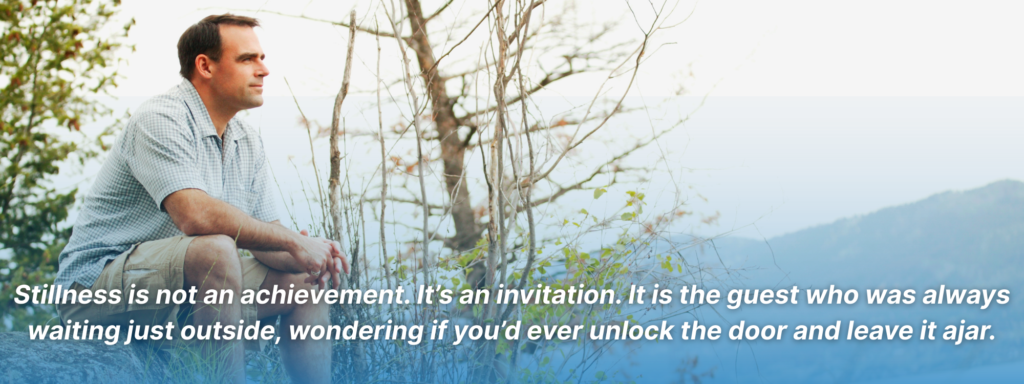
The Invitation of Stillness
It doesn’t begin with a grand revelation. No trumpet of clarity. No beam of light slicing through the ceiling. Just quiet. Uncomfortable, almost accusatory quiet. The kind that creeps in after you’ve run out of tasks to numb yourself with. You sit, not because you chose to, but because everything else failed to distract you.
The television mutters in the background. The kettle boils and cools. Somewhere in the distance, a dog barks like it’s calling you back into the world. You don’t move. Not yet. You don’t know it, but you’ve crossed the first threshold. Stillness isn’t absence. It’s presence, undistracted.
At first, it’s hard. The mind resists—offering lists, regrets, minor embarrassments from seventeen years ago. But then something softer begins to rise. Not peace, exactly. Recognition. A bird lands outside the window and you actually notice the way its chest rises and falls. You hear the fridge hum and, instead of resenting the sound, you marvel that something so ordinary has always been there, keeping you nourished. You realise you’ve spent so long pushing life away, braced against it, that you forgot it never stopped offering itself. Stillness isn’t retreat. It’s the doorway back in.
Amouria reveals itself in these places—not as something summoned, but something allowed. It arrives like dusk—gradually, subtly—until you realise the whole room has changed colour. It’s not magic. It’s the moment you stop trying to make beauty happen and instead let it happen to you. Stillness is not an achievement. It’s an invitation. It is the guest who was always waiting just outside, wondering if you’d ever unlock the door and leave it ajar.
Where We Miss It Most
We’ve been trained to override softness. Somewhere between deadlines and self-improvement, we picked up the idea that meaning must be earned—struggled for, sweated over, documented with photos and hashtags to make it count. Something beautiful happens, and we rush to capture it, prove it, post it. We’ve stopped trusting ourselves to feel it unless others see it too.
But it doesn’t play by those rules. It slips through filters. It can’t be stored. It happens in the moments we’re too busy to call moments. Folding laundry with your sleeves wet from rinsing dishes. Sitting on a crowded bus beside someone humming under their breath. The soft friction of your palm against your jeans when you wipe it absent-mindedly. The world offering itself in pieces, asking nothing in return.
We miss it not because we’re shallow, but because we’ve been told not to stop. Not to gaze too long. Not to get lost in anything that doesn’t generate output or prove utility. And so the ordinary becomes invisible. Familiarity blurs into blindness. Our very closeness to beauty makes it disappear.
But still, it waits. It never left. The colours still warm the walls at certain angles. The smell of cut grass still lingers longer than necessary. That old song still knows how to find you, even after all these years. It’s not that the world went quiet. It’s that we forgot how to listen. To live with amouria is not to search for beauty. It’s to stop covering your eyes.
And when you do—when you finally let stillness settle without suspicion—you begin to notice something simple, almost embarrassing in its softness: it was never that hard to feel joy. Only hard to stay still long enough to let it in.
It is Effortless
You’re already doing it. That’s the strange truth. You don’t have to learn it like you’d learn a language or a trade. You remember it. Like muscle memory. Like scent. Like the way your hand finds the light switch in the dark without thinking.
When you paused to listen to your child breathe while they slept—that was amouria. When you held someone’s hand in a hospital corridor and said nothing because nothing was needed—that too. When the song you hadn’t heard since you were young came on in a shop and for a few seconds you weren’t in the shop at all—that was it. You didn’t perform stillness. You inhabited it.
Amouria requires no discipline, it’s not self-improvement. It arrives when the thought of ‘improvement’ is momentarily forgotten. When we are not striving but noticing. It’s the small miracle of being claimed by the moment rather than trying to claim it.
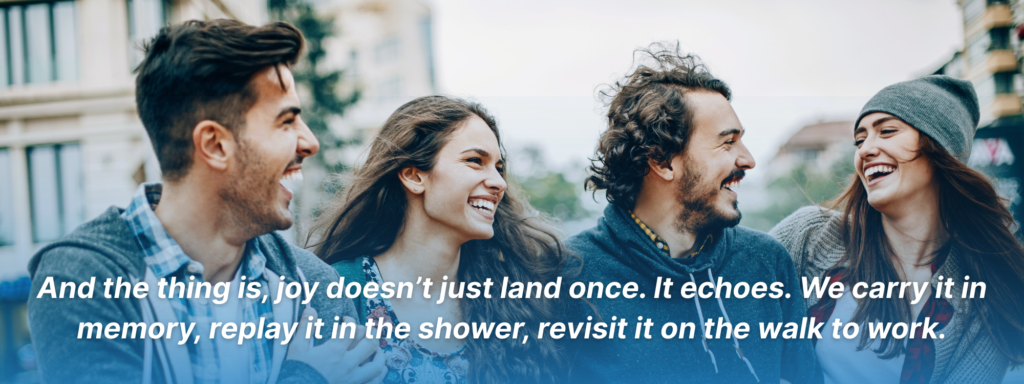
And the thing is, joy doesn’t just land once. It echoes. We carry it in memory, replay it in the shower, revisit it on the walk to work. It lives again in anticipation too, in the soft stretch of looking forward. When we remember something good or long for something good, we extend its reach across time. That’s a kind of power we’re rarely taught to trust.
Amouria is not a mystical state for the spiritually advanced. It’s the way your body leans toward warmth, your eyes linger on colour, your breath slows when the world softens. You don’t have to try harder. You only have to notice what already softens you—and stay a moment longer. Not to capture it. Just to let it settle, unguarded, into the centre of your life.
The Cost of Blocking Beauty
There is a cost to bracing. You don’t always see it at first. You just stop laughing from the belly. You say ‘fine’ instead of telling the truth. Music doesn’t hit the same, sunsets become background, and joy starts to feel like something other people have time for.
You become efficient. Controlled. Predictable. And quietly exhausted.
Because beauty, uninvited, stops knocking after a while. Not out of spite, but because it honours your decision not to be interrupted. The colour drains not from the world, but from your capacity to receive it. You miss the small, almost irrelevant things that once made you ache with gratitude.
You tell yourself this is strength—keeping pace, holding it together, never letting on. But you’re not holding it together. You’re holding yourself in.
And what you don’t release, you begin to forget. What you forget, you no longer expect. And what you no longer expect… rarely comes back.
Final Reflection
To live with amouria is not to retreat from the world, but to re-enter it with softness intact. It is a quiet act of resistance in a culture addicted to spectacle and speed. It is the choice to see, feel, and dwell—instead of scrolling past your own life.
It does not ask for belief. Only presence.
You will still face noise, disappointment, deadlines, grief. Amouria changes none of that. It changes you. Not into someone different—but into someone more available to the sacred ordinariness of things.
And that may be the most radical act of all: to let the world move you… and to let it move through.