
Origins of Belonging
Long before we had hashtags and iPads, all we had was each other. A time when survival wasn’t about optimising our calendar app or counting our steps, but about sticking close enough to your group so the sabre-toothed tiger didn’t make you its dinner. Life was brutal, pitiless and inconvenient. Comfort was a shared fire, not central heating. And yet, somehow, we made it through—because we weren’t alone.
Our nervous systems didn’t get their wiring diagrams in isolation. Safety wasn’t an internal memo; it was a shared state. If you weren’t safe with others, you probably weren’t safe at all. So, we forged pacts. Not legal contracts. Just simple, primal promises:
‘You protect mine. I’ll protect yours’.
It wasn’t utopia. It was necessity. Boys learned from men who’d survived long enough to tell the tale. Girls learned from women who’d carried, birthed and buried more than anyone should. There were rituals, of course—strange dances, cuttings, scarifications, and stories whispered under the stars. Not because they had cultural anthropologists to impress, but because passing the baton of adulthood required more than birthday cake and a driver’s licence.
And in these separate paths, something marvellous happened. Boys became men under the rough tutelage of other men. Girls became women under the stern care of women. Along the way, they forged bonds that were neither romantic nor familial but somehow just as vital. Friendships of the fiercest kind. Rivalries that cut, healed and taught. These bonds weren’t side plots. They were survival strategies.

Modern Crisis of Connection
Today, we’ve filed those bonds under a term as charming as a tax return: homosocial. A word you’d expect to find next to ‘isotope’ or ‘isometric’, not in the middle of something so human. Sociologists coined it, as they tend to do, and Eve Kosofsky Sedgwick gave it a masculine twist. But it applies across the board—non-sexual, same-sex friendships that are as foundational as the wheel. And, no, it’s not the same thing as being gay. Though saying someone’s ‘homosocial’ out loud in the wrong pub might still raise an eyebrow.
The real tragedy isn’t the awkwardness of the label. It’s that the bonds it describes have quietly been starved. Disappeared by design, perhaps. Or just neglected into non-existence. Either way, something precious has been lost: the solidarity of shared paths; the wisdoms passed down like family heirlooms; the kind of knowing only forged in the crucible of sameness. Not sameness in thought, but in experience. Men who know what it is to grow up fearing you’ll fail as a man. Women who know the quiet warfare of motherhood, ambition and impossible expectations.
Modern life, with its schedules and screens, has done a number on us. We’ve got more notifications than we’ve got confidants. More professional contacts than actual friends. For all our talk of connection, we’re lonely in ways our ancestors couldn’t imagine.
And it’s not just a Western problem. But the West, bless it, has industrialised isolation. In the pursuit of progress, it’s uncoupled ambition from community, fertility from family, and masculinity from meaning. Japan, South Korea, Germany—these aren’t backwaters. They’re paragons of modern achievement, economic miracles with population freefalls to match. Because when everything is individualised, including your identity, your job, and your living space, children start to look less like a blessing and more like an interruption. And no one queues up for interruptions.
Meanwhile, in parts of Africa, the Middle East, and South Asia, where the wi-fi might buffer but the kinship doesn’t, babies arrive with less hesitation. Not because women there lack choices, but because support still comes with the umbilical cord. The roles may be traditional—yes, even old-fashioned—but they’re clear. And clarity, for all its sins, offers direction.
It’s tempting, of course, to sneer. To call it patriarchy or matriarchy or any of the -archies we like to criticise. But look closer. Masculinity in many of these societies isn’t brute domination—it’s duty. Protection. Provision. A man earns his stripes not by avoiding commitment but by stepping into it. That might not fit the TED Talk, but it does fit the tribe.
Rediscovering Where We Belong
The truth is, not all traditional gender roles were prison sentences. Some were operating instructions. And within them, homosocial bonds did the heavy lifting. They offered men the room to be both tough and terrified. Women the space to be powerful without performing for men. Those bonds weren’t just sidekicks to marriage. They were a different kind of love story.
But these stories are harder to tell now. Because the spaces that once protected them—men’s clubs, women’s circles, communal gathering places—are either gone or gentrified. In their place, we have social media echo chambers and networking events that feel like speed-dating without the fun bits.
And yet, like an old fire rekindling in the ashes, something stirs. Men’s circles. Women’s retreats. Mentorship schemes that aren’t just about CVs but about souls. Spaces where people can show up without an elevator pitch. Where the language is less about optimisation and more about witness. Because sometimes, all you need is someone who understands why you’re crying without needing to ask.
Of course, technology isn’t the villain. It’s the tool. A well-aimed spade or a badly thrown brick. Used well, it can foster community across oceans. Used poorly, it fosters envy across the dinner table.
The way forward isn’t nostalgia. We don’t need to cosplay cavemen. But we might need to remember that civilisation didn’t start with cities. It started with someone staying up to watch while the others slept. It started with groups of women telling birth stories so a new mother wouldn’t feel alone. With men leaving with spears and returning with bruises, meat and respect.
To build what comes next, we’ll need both memory and imagination. We’ll need to reimagine gender not as prison walls but as scaffolding—structures to be built upon, not caged within. We’ll need to create spaces where men can be strong without being isolated, and women can be fierce without being flattened.
And around all this, we’ll need the campfire. Real or metaphorical. A place where stories are shared, rivalries softened, and silence isn’t awkward—it’s honoured. Where the question isn’t ‘What do you do?’ but ‘What keeps you going?’
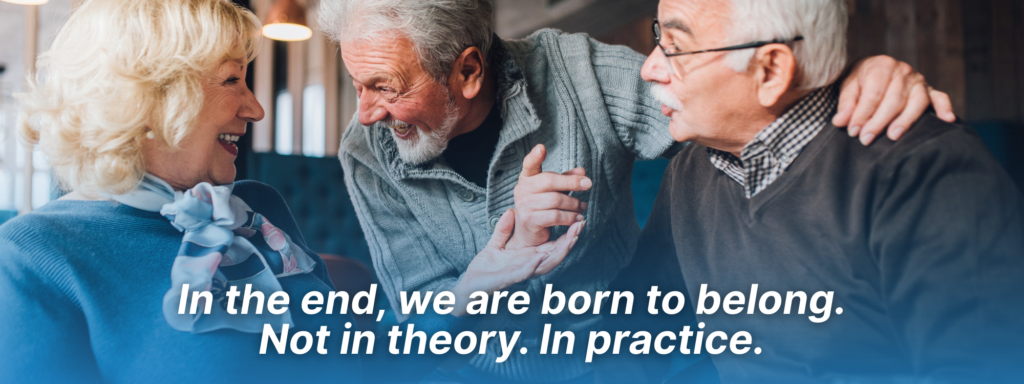
In the end, we are born to belong. Not in theory. In practice. In the sweat of shared work, the laughter of inside jokes, the comfort of being seen. Same-sex friendships won’t save the world. But they might just make it worth surviving.
So let’s gather again. Not as projects. Not as brands. As people. Around that flickering fire, telling the old stories—and maybe a few new ones—together.
Because we are built to belong.