
There is a certain heaviness that comes with leadership. Not the obvious kind measured in deadlines and deliverables, but the quieter pressure of being the person everyone turns toward when the air thickens. This weight arrives without ceremony. It accumulates slowly, like sediment, until one ordinary morning you realise you have been holding your breath for far longer than the situation requires.
Nothing dramatic triggered it. A colleague needed reassurance. A client wanted certainty. A team member spiralled and needed anchoring. None of these requests was unreasonable on its own. What makes them heavy is their constancy. A leader becomes used to lending their steadiness to others, and in doing so forgets that steadiness is not an inexhaustible resource.
The danger is not the weight itself. The danger is the quiet way it reshapes you while you are busy functioning. The signs are subtle. Your sentences shorten. Your humour dulls. Your shoulders rise a little more often. You become efficient in all the ways that comfort others and exhausting in ways that cost you.
When Responsibility Becomes Identity
Most leaders do not notice that they are losing themselves until the process is well underway. It happens through a thousand small concessions. The evening you answer emails despite promising yourself you would stop. The weekend you spend rehearsing a conversation in your head that could have waited. The morning you say yes to a request that did not belong to you because it felt easier than explaining why the answer should be no.
These are not failures. They are habits formed in the presence of other people’s expectations. Over time, the role expands until it begins to occupy the space where the rest of your life should be. You start to confuse your identity with your usefulness. You start to believe your value is measured by the weight you can carry without complaint. And you start to drift from yourself in the name of supporting others.
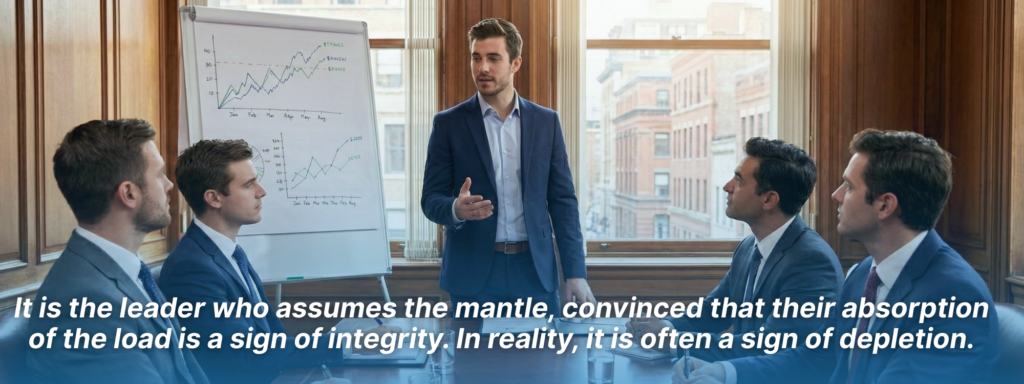
The saddest part is that most teams never ask for this sacrifice. They may benefit from it, but they did not request it. It is the leader who assumes the mantle, convinced that their absorption of the load is a sign of integrity. In reality, it is often a sign of depletion.
Boundaries as Acts of Leadership
There is a misconception that boundaries limit generosity. Yet the opposite is true. Boundaries preserve the part of you that generosity comes from. Without boundaries, a leader becomes a collapsing structure held together by obligation. With them, a leader becomes someone whose steadiness is genuine rather than forced.
A boundary is not a barrier. It is an anchor. It reminds you where your responsibility ends and where someone else’s begins. It stops you from rescuing people who need to learn and from absorbing stress that does not belong to you. Most importantly, it keeps your nervous system from operating in a state of permanent readiness.
Teams can feel when a leader lacks boundaries. They sense the leader’s exhaustion even when the leader insists they are fine. They become cautious, as if walking around a structure that looks solid but feels brittle. Conversely, when a leader sets boundaries, the room often relaxes. Clarity enters. Expectations become explicit. People know where they stand. And the leader regains the ability to give without resentment.

Delegation as Self Preservation
Delegation is often presented as a productivity strategy. That framing is insufficient. Delegation is an act of self preservation. It prevents the leader from becoming the single point of emotional and operational failure within the system. It protects identity from being consumed by function.
A leader who attempts to carry everything eventually becomes someone the team must carry. Not metaphorically, but literally. They become reactive, brittle, short tempered, or withdrawn. They become a variable that must be managed rather than a source of clarity that steadies others.
Delegation is not the abandonment of responsibility. It is the distribution of it. It allows others to build competence. It signals trust. It forces the leader to confront the uncomfortable truth that they are not the only capable person in the room, and that their need to hold everything may be masking a deeper need to feel indispensable.
Letting others carry part of the load is not a loss of relevance. It is a restoration of proportion.
Staying Human & Responsible
Leadership is, in many ways, the act of remaining human under conditions that invite distortion. It is easy to become a function. It is easy to become a role. It is easy to become a repository for other people’s uncertainty. What is difficult is to retain the shape of the person you were before you inhabited the title.
There is a point at which the most responsible thing you can do is step back far enough to see yourself clearly. To notice that fatigue has become a personality trait. To notice that silence has replaced humour. To notice that people defer to you not because you are leading well but because they sense your fragility and do not want to add to it.
Returning to yourself is not indulgent. It is necessary. You cannot lead sustainably if the person leading evaporates. You cannot model steadiness if your inner life is collapsing. You cannot claim clarity if you have forgotten what you think outside the noise of other people’s needs.
Leadership is not the art of carrying everything. It is the art of carrying what is yours, sharing what is not, and remaining recognisably yourself throughout the process.

Leadership Boundaries: What Endures When the Weight Shifts
Eventually every leader discovers that weight is not the enemy. The loss of self is. The work is to remain intact while carrying what must be carried. To refuse the slow erosion that comes from chronic over functioning. To stay in relationship with your own motives, your own limits, and your own humanity.
No applause accompanies this discovery. No announcement marks the moment. But those who work with you will feel the difference. You will become easier to follow, easier to trust, and easier to speak honestly to. You will be a person again, not just a function. And that restoration, though invisible from the outside, is one of the highest forms of leadership there is.