
The office door is closed. Not slammed. Just firmly shut. Inside, a desk wide enough to land a small aircraft. Outside, a corridor where conversations lower a notch as they pass.
People knock before entering. Updates are delivered upward. Instructions travel down. Decisions are announced with the tone of a weather forecast. ‘This is what we’re doing.’ Questions are tolerated, provided they are brief and preferably rhetorical.
The boss occupies the office.
Now picture another version of authority. Same title. Same accountability. No smaller desk. But the door is open more often than not. The leader walks the floor. Knows names. Stops mid-stride to ask what is working and what is not. Listens long enough to hear more than the first sentence. When decisions are made, they are explained. Not justified, not apologised for. Explained.
Authority is still present. But proximity is different.
For generations, power was confused with distance. The further you were from the shop floor, the classroom, the ward, the depot, the more important you must be. Authority was demonstrated by how little you revealed and how quickly you spoke. A certain tone, a certain posture, a certain narrowing of the eyes that said, without words, ‘I am in charge here.’
In short bursts, this works. Fear can create speed. Silence can look like compliance. A sharp directive can move a stuck team like a cattle prod through fog.

Authority in Practice: Behaviour vs. Belief
Over time, however, the returns diminish. People begin to deliver what is asked, not what is needed. Information becomes curated. Risk is hidden. Initiative withers. The room still moves when the boss speaks, but it moves with the enthusiasm of someone doing just enough to avoid trouble.
The shift from boss to leader is not about removing authority. It is about refining how it operates.
A boss often starts with behaviour. ‘Do this.’ ‘Stop that.’ ‘Deliver by Friday.’ The assumption is that if behaviour improves, everything else will follow. Sometimes it does. Many times it does not.
A leader understands that behaviour is rarely the first domino. Beliefs about fairness, identity, capability and belonging sit underneath it. If trust is present and experience exists, deeper conversations are possible. If those foundations are thin, clarity and structure are required first. The point is not to default to one mode. It is to read the room.
Consider feedback.
A boss says, ‘You were disengaged in that meeting.’ The word lands like a verdict. Defensive shutters rise. The conversation becomes a debate about personality.
A leader says, ‘I noticed you were quiet, head down, and did not contribute. What was happening?’ No diagnosis. Just observation. The shift is subtle and enormous. One approach interprets. The other describes. One assigns motive. The other invites explanation.
Precision, Accountability, and Team Dynamics
This is not softness. It is precision.
Precision allows accountability without humiliation. It separates the person from the performance. It keeps standards high while keeping dignity intact. A leader can say, ‘The outcome missed the mark. Here is the data. Let’s walk through it,’ without turning the exchange into theatre.
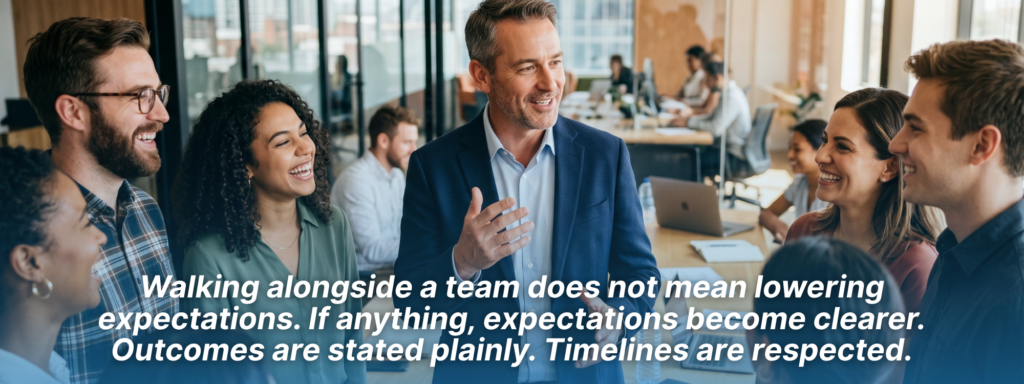
Walking alongside a team does not mean lowering expectations. If anything, expectations become clearer. Outcomes are stated plainly. Timelines are respected. Feedback is given in language that can be verified rather than argued with. ‘You were late twice this week’ is cleaner than ‘You are unreliable.’ The first can be addressed. The second breeds resentment.
The boss enforces compliance. The leader builds commitment.
Part of this shift requires recognising that not everyone is motivated by the same levers. Some people are wired for speed and results. They want clarity, direction and momentum. They value decisiveness. Others are wired for connection and morale. They want context, collaboration and acknowledgement. They value inclusion.
A boss tends to favour whichever pattern mirrors their own. The fast ones get impatient with what they see as dithering. The relational ones grow frustrated with what they experience as bluntness. Teams fracture along invisible fault lines.
A leader flexes. With the outcome-driven colleague, they are direct and concise. Time is respected. With the relationship-driven colleague, they establish connection before diving into task.
The Internal Shift and Cultural Calibration
Context is shared. The tone shifts without compromising the goal. This is not pandering. It is accommodation in service of performance.
Walking alongside means remaining visible. It means being accessible without becoming dependent on being liked. It means explaining your thinking rather than hiding behind position. It means inviting challenge, then making the decision calmly and standing by it.
It does not mean becoming a friend. It does not mean oversharing your private doubts to secure sympathy. It does not mean avoiding conflict because it feels uncomfortable. Authority remains. It simply stops relying on volume.
The internal shift is the hardest part. If you need your title to feel safe, you will cling to hierarchy. If disagreement feels like disrespect, you will tighten control. If silence in a room makes you anxious, you will fill it with directives.
The boss asks, ‘How do I assert authority?’ The leader asks, ‘How do I earn followership?’ One is concerned with position. The other with credibility.
This difference becomes especially visible across sectors. In a factory, a school, a hospital, an emergency service, the pattern holds. The supervisor who only appears to correct mistakes creates a culture of concealment. The one who appears to understand the work, who observes carefully, who holds standards without theatrics, creates a culture of ownership.

Cultural Nuance and the Symbol of the Door
Cultural nuance complicates the picture further. What looks decisive in one context may appear abrasive in another. What looks collaborative in one culture may appear indecisive elsewhere. Leaders who assume their style translates universally are often bewildered when it does not. Leaders who calibrate to how they are being received retain influence across difference.
In the end, the office door remains a useful symbol. Closing it entirely may protect power, but it also reduces signal. Opening it indiscriminately may blur boundaries. The leader learns when to close it for focused work and when to open it to extend influence.
The shift from boss to leader is not a demotion of authority. It is an elevation of responsibility. It demands more awareness, not less. More restraint, not more force. More listening, not more talking.
A boss occupies the office. A leader occupies the space between people.
That space is where performance either withers or grows.