
The argument begins, as it always does, with something too small to justify what follows.
The bin lid does not close properly. The dishwasher hums but remains half-empty. A message goes unanswered for longer than it should. Nothing here would interest a court of law. Nothing here would make a headline. And yet the air in the kitchen shifts as though a storm front has nudged the coast.
‘Did you forget to reply to them?’ she asks, wiping her hands on a tea towel that has seen better days.
It is a reasonable question. Calmly phrased. Eight words, no exclamation marks.
He hears something else.
His jaw tightens, just enough to register if he were looking for it. He is not. His shoulders lift half an inch. His breath stops short of a full length and decides, apparently, that this will do.
‘Not yet,’ he says.
That should be the end of it. It never is.
Somewhere behind his eyes a sentence has already taken its seat. ‘Here we go again.’ It arrives early and settles comfortably, like a regular in a pub who does not need to see the menu. On her side of the counter, another line stretches its legs. ‘I have to do everything.’ Neither sentence is spoken. They do not need to be. They have history.
You have had this argument before. Not once. Not twice. Forty-seven times, give or take a Christmas.
When the Argument Starts Before the Words
The subject changes, but the choreography does not. A small request. A slight edge in tone. A defensive reply. A reminder of a previous offence. The word ‘always’ makes its entrance, dramatic and unhelpful. ‘You always leave it to me.’ ‘You always overreact.’ The word ‘never’ follows close behind, eager not to be left out. ‘You never listen.’ ‘You never think.’
The bin is no longer about rubbish. The unanswered message is no longer about admin. The dishes are no longer about dishes. They have been promoted. They now represent care, respect, effort, value. They carry far more weight than porcelain or plastic can reasonably bear.
It feels predictable because it is rehearsed.
Each of you enters with a file already open. A catalogue of previous incidents. A mental montage that plays at impressive speed. The brain is nothing if not efficient. It does not treat this as a fresh moment. It treats it as episode forty-eight of a long-running series. The theme music starts before you consciously hear it.
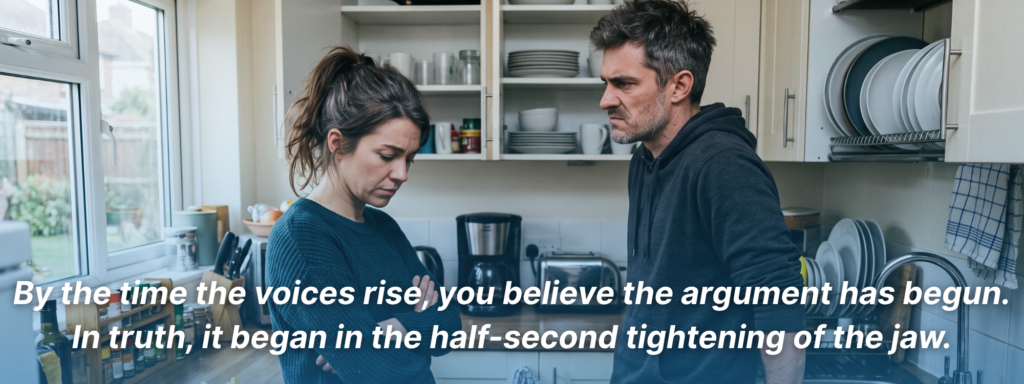
By the time the voices rise, you believe the argument has begun. In truth, it began in the half-second tightening of the jaw. In the sentence that slipped in before the words did. ‘Here we go again.’ ‘I have to do everything.’ Small, private verdicts passed in silence.
Once that verdict is in place, the rest follows with grim determination.
You start scanning for evidence. The way he shrugs. The way she sighs. The precise volume of the cutlery placed back in the drawer. Each detail is gathered and filed under ‘always’. The present moment barely stands a chance. It has to compete with accumulated proof.
Argument Becomes Something Bigger
What makes this argument so wearying is not its heat. It is its familiarity. You know the lines. You could deliver your partner’s next sentence for them, with accurate tone and punctuation. There is something almost impressive about the symmetry of it. If only it were not so exhausting.
The odd thing is this: if an outsider walked into the kitchen at this stage, they might struggle to see the problem. Two adults discussing a minor oversight. Mildly tense, perhaps. Not catastrophic. Yet inside the room, the stakes feel absurdly high. The temperature has risen. The chest feels tighter. The words are carrying more force than their syllables justify.
That is because the argument is no longer about what happened tonight. It is about what this moment seems to confirm.
The unwashed dish is not a dish. It is ‘I am not supported’.
The unanswered message is not a message. It is ‘I am not important’.
The late arrival is not lateness. It is ‘I do not matter’.
These translations happen quickly. You do not sit down and decide to convert crockery into existential threat. The shift is automatic and, if you are not paying attention, invisible. One minute you are discussing logistics. The next you are defending your place in the relationship as if it were a contested border.
No one set out to fight about belonging. And yet, that is often where it lands.

How “Always” Changes the Argument
By the time one of you says, ‘You always do this,’ the room has already moved beyond the original incident. The word ‘always’ is doing heavy lifting. It reaches backwards through months and years, dragging old grievances into the present like unwanted guests. Specific complaints can be addressed. ‘Always’ cannot. It is too large. Too vague. Too armed.
This is why the argument feels endless. You are not arguing about tonight. You are arguing about a pattern that has been given the dignity of permanence.
And permanence is hard to negotiate with.
Permanence is a brutal thing to argue against.
If it is ‘always’, then why bother trying. If it is ‘never’, then what hope is there. The words inflate the problem until it barely fits in the room. You are no longer two people disagreeing about a task. You are two characters locked into roles: the careless one, the controlling one. The overreactor. The avoider. Parts assigned. Lines memorised.
What Sits Beneath the Argument
Underneath the repetition, though, there is something softer and far less theatrical.
There is fear.
Not the cinematic sort. Not terror. Just the quieter anxieties that sit behind most long-term arguments. The fear of being taken for granted. The fear of being judged. The fear of not being valued. The fear of being swallowed up by someone else’s expectations. The fear of being invisible in your own home.
The bin is not the bin. It is ‘I am doing this alone’. The defensive shrug is not a shrug. It is ‘I am not enough’. When you strip away the volume and the posture, what remains is usually a pair of people guarding something tender with rather clumsy weapons.
It does not feel tender in the moment. It feels sharp. Efficient. Justified.
‘Why should I have to say this again?’ she thinks.
‘Why am I always being corrected?’ he thinks.
Neither is thinking, ‘I am afraid you don’t see me.’ That would require a different tone. And a different level of exposure.
How the Argument Escalates
Instead, the pattern takes over.
Here is how it usually unfolds. One of you raises the issue. The other hears accusation rather than information. The shoulders stiffen. The voice tightens. A counter-attack arrives, modest at first. ‘Well, you didn’t…’ The original point is now lost in a contest of evidence. Two lawyers arguing precedent. No judge in sight.
By minute three, you are both arguing about tone.
‘Don’t speak to me like that.’
‘I’m not speaking to you like anything.’
Tone has become content. The dishes sit, untroubled by their symbolic status. The relationship, however, is now under review.

Shrink the Argument Back to the Moment
The exhausting part is not that you disagree. It is that you disagree in the same way every time. The same escalation. The same defensive posture. The same closing move, often a withdrawal. One of you goes quiet. The other feels unheard. The room cools, but nothing is resolved. The file marked ‘always’ grows thicker.
You do not need a revolution to change this. You need a smaller interruption.
Not a lecture. Not a dramatic vow. Something almost embarrassingly modest.
Shrink the argument back to the moment.
Remove the word ‘always’. Remove ‘never’. They are doing far more damage than they are worth.
Instead of ‘You always leave it to me’, try, ‘Last night, when the dishes were left, I felt overwhelmed’.
Notice what has changed. The time frame is narrower. The accusation has become an experience. You are no longer presenting a character judgement. You are describing a moment.
It sounds minor. It is not.
Specific complaints can be addressed. ‘Last night’ can be discussed. ‘Always’ cannot. One is a scene. The other is a sentence carved in stone.
Before you say even that much, there is another adjustment available, quieter still. The breath.
In the heat of repetition, your partner hears tone before meaning. If the sentence is technically fair but delivered with a tightened jaw and a raised volume, the body on the other side will brace. Once braced, it listens for threat, not content.
One Full Exhale
So pause. One full exhale before you speak. Drop the shoulders an inch. Loosen the jaw. You are not trying to become serene. You are simply lowering the temperature enough for the words to travel.
Try it in the kitchen.
‘Last night, when the dishes were left, I felt overwhelmed.’
Not shouted. Not flung. Placed.
Your partner may still react defensively. Patterns do not vanish at the first hint of reform. But something subtle has shifted. You have moved from indictment to information. From character to moment. From ‘you are this’ to ‘this is what happened’.
That shift alone can shorten the argument by half.
You might protest that you are tired of going first. That you have been the reasonable one before. That fairness demands symmetry.
All of that may be true.
The question is not who deserves to adjust. The question is whether you want to have this argument for a forty-eighth time.
Repetition feels powerful because it is familiar. Breaking it feels vulnerable because it is new. But vulnerability here is not grand confession. It is the choice to stay in the present moment rather than drag the entire archive into the room.
Next time the irritation rises, watch for the familiar sentence. ‘Here we go again.’ ‘I have to do everything.’ Catch it before it settles.
Remove ‘always’. Remove ‘never’. Anchor the complaint to one moment. Speak it after one full exhale.
You are not trying to fix the relationship in one evening. You are refusing to rehearse the same script.
The argument you have had forty-seven times does not end because someone finally wins it. It ends, slowly and imperfectly, because one of you declines to perform it in quite the same way.
And sometimes, that is enough to change the ending.