
Most HR nightmares do not begin with a bang. They begin with a shrug.
A shrug in the corridor after a meeting. A laugh that lands half a beat late. A tone in an email that has lost its vowels. A good performer who stops bringing you problems and starts bringing you compliance. The formal complaint, the sick leave, the ‘I just need a quick chat’ with someone from People and Culture arrives later, wearing a polite face and carrying a file. By then, the system has already decided what it thinks you should have noticed.
‘Reading between the lines’ makes it sound mysterious. Like you’re Sherlock Holmes in a fleece vest, sniffing out motive from a coffee stain. In reality, it is blunt and sensory. It is the ability to notice when the room is lost, before it knows it is lost. Slowly then all of a sudden. Like missing the first step on a staircase you were certain was there. One moment you are running the meeting, and the next you are the meeting.
The pivot is always the same. The gaze shifts. The group looks at the disruptor, then back at you, and there it is, the unspoken verdict:
‘We’ve noticed. So, what are you going to do about it?’
Not the behaviour itself, not even the comment, but the group’s decision about whether you still hold the permission to manage it. Managers who mistake leadership for control, and control for correction, walk straight into that trap. They swing their attention at the offender like a disapproving headmaster, forgetting that this is not a one-on-one exchange. It is a room full of silent jurors, watching to see whether you will either overreact, underreact, or do the rare thing and respond with timing.
Timing is where most leaders bleed out.
Over-intervene and you steal the group’s autonomy, then wonder why they behave like people waiting to be told what to do. Wait too long and you lose the right to intervene at all, because the group has already moved on to building its own immune response, usually in the form of eyerolls, side jokes, and private messages that start with
‘Can you believe…’

Authority in a group setting is not a title. It is a lease. Renewed in seconds. Miss a payment and the group starts shopping around.
This is where ‘biological signals’ matters, provided we do not treat it like witchcraft. We are not diagnosing, labelling, or playing amateur therapist. We are observing, in plain sight, the small physiological shifts that show when a person or a room is sliding out of stability and into something more combustible. The body always votes first. The mouth just files the paperwork later.
The problem is that most leaders do not observe. They interpret. They see a quiet person and decide they are disengaged. They hear a clipped answer and decide the person is hostile. They notice a frown and decide it is directed at them, because leaders, like most human beings, are not immune to the belief that the world revolves around their own sense of being judged. Interpretation is quick, satisfying, and usually wrong. Observation is slower, less flattering, and useful.
Observation sounds like this:
‘He spoke less than usual today.’
‘She did not make eye contact when the topic came up.’
‘His breathing got higher and his shoulders rose when we discussed workload.’
‘She laughed when everyone laughed, but her face did not move.’
These are not accusations. They are data. And data has a unique property in human systems. It can be checked.
Checking requires one thing most leaders forget to schedule. Presence.
You cannot read the room if you are half inside your laptop. You cannot notice a shift in tone if you are rehearsing your rebuttal while someone else is speaking. You cannot calibrate a baseline if you only engage people when you need something. The leader who wants to catch the problem early has to build the conditions early, in the minutes before the meeting begins. A quiet welcome. Warm eye contact. A respectful joke that does not punch down. An acknowledgement that says, without fuss,
‘I see you, and I will still see you when things get tense.’
That is not niceness. That is leverage.
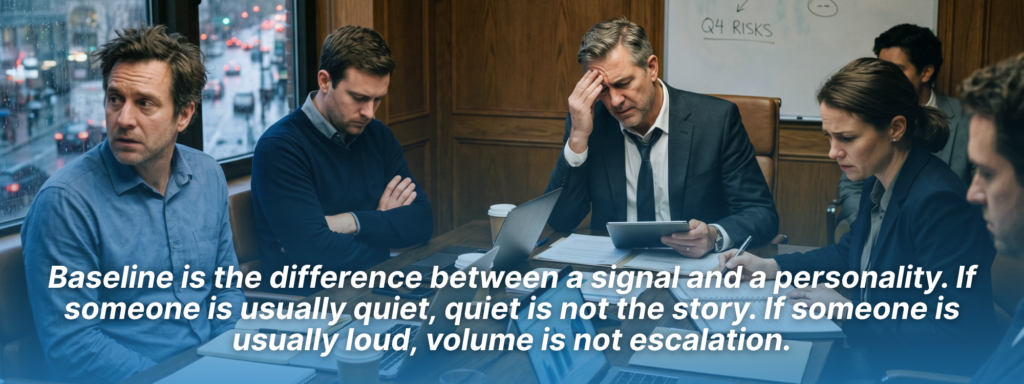
Baseline is the difference between a signal and a personality. If someone is usually quiet, quiet is not the story. If someone is usually loud, volume is not escalation. The thing that matters is deviation. The person who always banters, then does not. The person who always contributes, then stops. The person who always challenges, then becomes oddly agreeable. Sudden compliance can be more dangerous than open disagreement. Open disagreement at least keeps the system honest. Compliance can be the sound of someone giving up, and giving up is when people start documenting.
There are a handful of signals that tend to show up before the email to HR is drafted. Not always, not in everyone, and not in neat order. That is the point. Humans are not spreadsheets.
Breathing changes are one. Not in the abstract, but in the way you can actually see it. The chest rising higher, faster. A breath held while someone speaks, as if the room has turned into deep water. A long exhale after a decision is announced, like a tyre losing air. Posture is another. Collapsing into the chair, shoulders forward, head down, as if the person is trying to reduce surface area. Or the opposite, rigid uprightness, arms crossed, jaw tight, the body bracing for impact. Voice changes matter too. A pitch that rises, words that speed up, sentences that end without a full stop. Or a flattening, monotone delivery that suddenly makes everything sound like it has stopped mattering.
The room also signals as a unit. If humour dies, pay attention. If the side comments stop, pay attention. If the group goes quiet in a particular corner, pay attention. A group can go quiet in a good way, when people are thinking. It can also go quiet like a waiting room, when people are waiting for the pain to begin. The difference is in the quality of the silence. One feels settled. The other feels held.
Now, here is where ethics comes in. If you notice these shifts, you do not weaponise them. You do not announce, in front of everyone,
‘You seem stressed.’
You do not attempt to expose a person’s internal life like a magician pulling scarves out of someone’s mouth. That is not leadership. That is theatre. And the crowd will not thank you for it.
Instead, you ask small, private, specific questions that leave room for dignity.
‘You were quieter than usual today. Have I missed something?’
‘You seemed to hesitate when that topic came up. Is there anything we should talk through?’
‘Your workload looks heavy. Are you coping, or are you just being brave?’
These questions do not assume motive. They invite information. They create a narrow intervention window where the issue can be resolved while it is still a conversation, not a case.
This is also where many leaders reveal their default style, and it matters. Some lean towards the sharp, decisive intervention. They are comfortable with confrontation, quick to correct, prone to pounce. Others lean towards accommodation, warmth, and endless patience, and can wait long past the point of rescue. Both types can be excellent. Both types can get a room killed.
The decisive leader must practise the sacred pause. One beat longer than feels comfortable. That beat is not empty. It is data. It tells you whether the group is self-correcting, whether the disruptor is being socially contained by peers, or whether the group is looking at you with that particular blend of expectation and disappointment that says your authority is evaporating.
The accommodating leader must practise assertive discomfort. Speaking sooner, not later. Saying the necessary thing before it is perfectly phrased. Interrupting the spiral before it wraps the whole meeting in cling film.
The distinction is not between ‘nice’ and ‘tough’. It is between reactive and deliberate. Between impulse and choice. Between the leader who acts because they cannot tolerate discomfort, and the leader who acts because the system needs containment.
Containment is not domination. It is holding the space long enough for the group to breathe.
This matters most in the moments after bad news. Redundancies. Lost contracts. Safety incidents. A public failure. The words land, and then the room needs time to absorb them. Many leaders fill that time with more words, because silence feels like weakness. In fact, silence is often the only honest response. If you keep talking, you prevent reality from arriving. If you pause, the room settles into comprehension. You can almost feel it happen.
Bodies still.
Eyes fix.
Breath shifts.
People do the private maths of mortgage payments, school fees, pride, and fear. Your job is not to soothe them with chatter. It is to remain steady enough that their nervous systems do not need to protect themselves from yours.

This is the invisible return on regulation. When you stay coherent, others regain coherence faster. When you stay calm without going cold, people can think. When you hold boundaries without humiliation, people can speak without flinching. The opposite is also true. If your tone sharpens, if you fidget, if you fill silence with nervous explanation, the room reads it as danger. And then you are not leading. You are leaking.
It is worth saying plainly. None of this is about becoming a mind-reader. It is about becoming less of a storyteller.
The moment you attach a story to someone’s behaviour, you stop seeing them. You start seeing your own narrative about them. That is when leaders drift into judgement, and judgement is the fastest route to miscalibration. The skill is to notice, check, and respond early, with proportionate action. Sometimes that action is a quiet question. Sometimes it is a boundary. Sometimes it is letting the group’s immune system do its work, while you hold the space and watch the weather.
And sometimes, when a bully steps in and turns a room into a hostage situation, it is power, calmly applied, that restores safety. Not drama. Not rage. Just clarity.
‘One voice at a time. That includes everyone. We are moving on.’
The group does not need you to win. It needs you to protect the contract that makes conversation possible.
If you want to avoid HR nightmares, you do not wait for the complaint. You do not wait for the blow-up. You do not wait for the resignation that begins with,
‘I’ve been thinking for a while…’
You read what is already being written.
In the breath that changed. In the posture that collapsed. In the humour that stopped. In the silence that grew teeth. In the moment the group looked at the problem, then looked at you.
And you act, early, privately, and with enough steadiness that the room does not have to protect itself from you.
Because HR nightmares rarely begin with shouting. They begin with silence. And silence, in a team, is never empty. It is full of things people stopped believing they could say out loud.