
Leaders often think psychological safety is built through grand gestures: well-crafted values statements, passionate speeches about culture, or highly facilitated team sessions designed to coax a sense of trust into existence. Yet trust rarely appears in such moments. It forms instead through smaller and far less glamorous interactions. These interactions are short enough to miss if you are not paying attention, but potent enough to shape the emotional climate of an entire team.
A raised eyebrow at the wrong moment can silence someone for a month. A well-timed nod can give a hesitant colleague the courage to continue their point. A pause before responding can soothe a brewing conflict. These micro moments accumulate. They create impressions that turn into expectations, and expectations that turn into culture. People do not remember every meeting, but they remember how a leader made them feel within the first five seconds of speaking.
Psychological safety is not an initiative. It is a pattern. And the pattern is written in micro gestures.
The First Language of Leadership
Before a leader says a word, the body has already spoken. Teams listen to posture and tone long before they consider content. A relaxed jaw communicates openness. A clenched jaw communicates judgement. Shoulders slightly lowered suggest receptivity. Shoulders pulled back too sharply suggest impatience. Even the direction of the leader’s gaze creates a hierarchy of attention that people read with remarkable accuracy.
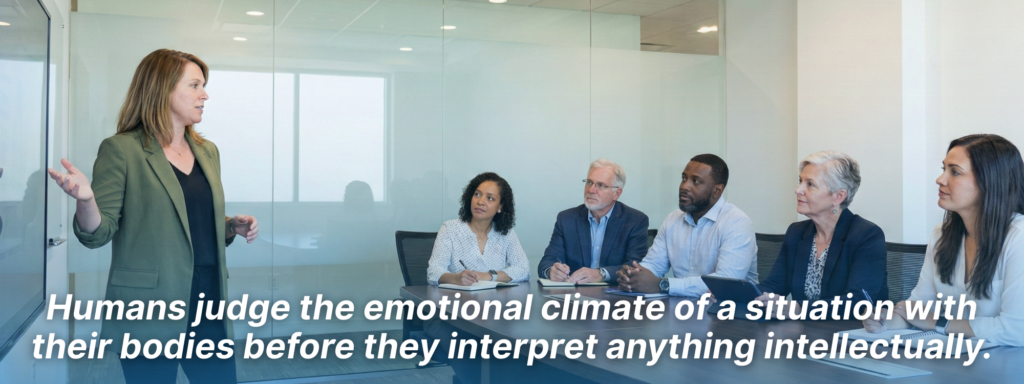
These signals are not ornamental. They are the primary indicators of threat or safety. Humans judge the emotional climate of a situation with their bodies before they interpret anything intellectually. If the leader’s state feels constricted, the team constricts in response. If the leader approaches with steadiness, the team relaxes into its own intelligence.
The body broadcasts intent, often more honestly than language. You cannot fake calm for long. You cannot fake interest without paying an emotional price. Teams register micro incongruence with the sensitivity of a tuning fork. This is why psychological safety is rarely a matter of what leaders say, but how they arrive.
Micro Threats
A single micro threat can shift the behaviour of an entire group. A sigh at the wrong moment can imply disappointment. A comment delivered with a harder tone than necessary can imply judgement. Even a subtle tightening around the eyes can communicate irritation. These signals might seem trivial to the leader, but they land heavily on the team, particularly on those whose psychological safety has been shaped by previous environments.
Micro threats accumulate. They form a narrative that often begins with the phrase, It is safer not to say anything. Once this narrative takes hold, innovation stalls. People contribute only what is expected. Initiative disappears. Meetings become performances rather than collaborations. None of this is dramatic. It is simply the quiet reorganisation of human behaviour under conditions of perceived threat.
The tragedy is that leaders rarely intend these effects. They simply fail to notice the signals their bodies broadcast while their minds are elsewhere.

Micro Affirmations
Micro affirmations carry equal power in the opposite direction. A small gesture of presence can reopen the conversational space that a previous threat constricted. A slow nod gives permission. A softer tone gives reassurance. A moment of silence that is held without tension gives dignity to the person speaking. These gestures are the building blocks of trust.
Micro affirmations are not cheerleading. They are signs of respect. They tell the other person, I am here, I am listening, and I am not rushing your meaning. They expand the psychological space of the room and allow more of the person’s thinking to surface. When these gestures accumulate, people begin to take interpersonal risks. They share earlier. They admit uncertainty. They reveal mistakes before mistakes turn into consequences.
Psychological safety grows not through declarations but through hundreds of small interactions that tell people they matter without demanding they perform.
State as the Origin Point
Every psychological climate originates in the leader’s state. If the leader is hurried, people speak quickly. If the leader is tense, people become cautious. If the leader is curious, people become expansive. State is contagious. It spreads through a team with the precision of an electrical current, shaping behaviour long before content does.
A leader who wishes to build psychological safety must therefore begin with their own nervous system. Not by suppressing emotion, but by regulating it. Not by pretending to be calm, but by returning to calm. Not by demanding openness from others, but by modelling the conditions that make openness possible.
Teams do not trust a leader who cannot regulate themselves. They trust a leader who can remain grounded even when the conversation becomes uncomfortable. Safety begins with the leader’s capacity to hold their own internal weather without forcing others to carry it.

The Unseen Structure of Culture
Culture is often described as a set of values or behaviours. This definition is tidy but incomplete. Culture is the sum of micro moments that accumulate into norms. It is the way people breathe around each other. It is the ease with which they share uncertainty. It is the absence of fear when naming a problem. These are not visible on posters or PowerPoint slides. They are visible in how people speak in the first thirty seconds of any meeting.
If the team believes that the leader will respond with steadiness, culture becomes spacious. If the team believes that the leader will react unpredictably, culture becomes constricted. This transformation does not require a dramatic moment. It requires repeated micro interactions that point consistently in one direction.
A Necessary Insight
Ultimately, leaders realise that psychological safety is not built during the large, planned conversations, but in the small, unplanned ones. It is built in how they greet someone. It is built in how they pause before responding. It is built in how they hold eye contact without forcing it. It is built in the breath they take before interrupting. It is built in every micro choice that signals either, You are safe to be real here, or, You are safer withholding.
The work is subtle. The consequences are significant. Micro moments determine whether a team guards itself or reveals itself. They determine whether innovation feels possible or reckless. They determine whether people lean in or pull away.
Psychological safety is not a promise. It is a practice. And the practice begins with the smallest moments, where the leader’s state meets someone else’s courage.